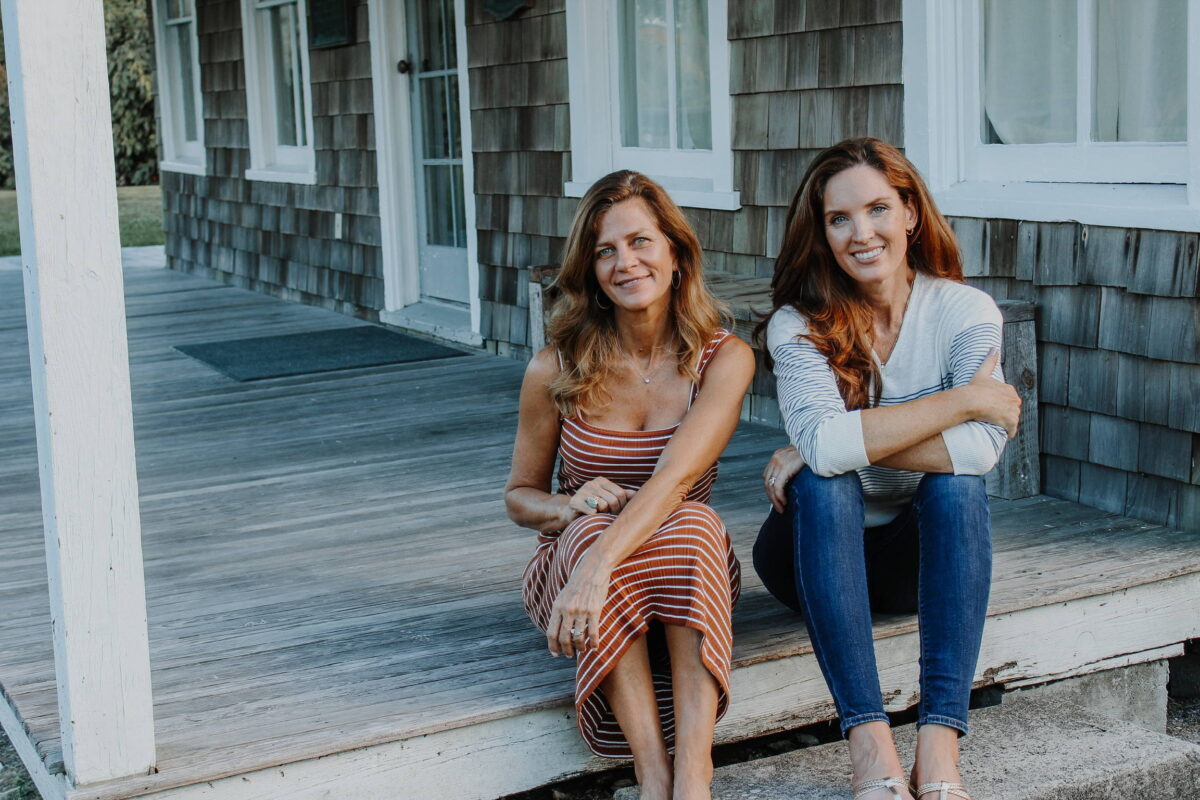
Dorian and Alexandrina Filip, the couple behind DSF Antique Jewelry, at their apartment in New York City. (Sam)
How a Romanian immigrant discovered a new path in America
Dorian Filip was a massage therapist in 2009, working aboard the Seabourn Odyssey on its maiden voyage around the Mediterranean. After some years in the industry, he had developed aches in his neck, shoulder, and hands that were increasingly painful, and thoughts of quitting were on his mind.
“I said, ‘If nothing works, I’ll go to the army—I’ll go spend five years there, and they’ll give me a pension after.’”
One fateful day, Filip was assigned to take care of one of the cruise passengers, Brian Albert, who had booked a spa appointment. The two struck up a conversation about life plans. Albert is a wholesale jewelry dealer, with an eye for spotting beautiful things from a young age; when he was 16, he started buying up trinkets at junk shops and selling them to family and friends.
Albert invited Filip to come to New York and learn the trade. Filip was unsure if this was his path, but Albert encouraged him.
“He asked me, ‘What do you like in life?’ And I said a few things that I liked,” such as cars and watches, Filip said. “He said, ‘If you like and understand those things, you’ll understand jewelry too.’”
American Dream
Filip took a leap of faith; about three months after that cruise, he flew to New York from his home country of Romania.
“In the beginning, I couldn’t really tell what was costume jewelry or what was really fine jewelry,” he said, referring to jewelry made with imitation gems or inexpensive materials, versus pieces crafted with precious metals and gemstones. “It was a little confusing.” Albert brought Filip to trade shows, antique shows, and estate sales, showing him the ropes of how to procure exquisite pieces for a bevy of Madison Avenue fine jewelers.
A Tiffany & Co bracelet with rubies and sapphires. (Sam)Vintage Chanel earrings. (Sam)
Albert tends to buy from estates and other dealers, so as to procure for his clients one-of-a-kind items they haven’t seen before. He also taught Filip the importance of maintaining long-term relationships with clients—Albert is the kind of person who would throw cocktail parties for cruise staff, or meet a maitre d’, become fast friends, and sometime later end up on a vacation in Hungary together.
“We have been dealing with the same people … for 30, 40 years, and even longer,” Albert said.
There are plenty of fascinating stories from traveling around the world in search of beautiful jewelry. Albert recounted a time when he was visiting Turkey while on a cruise trip. He walked into a local shop and began chatting with the store operator.
“He pulled the box out of the safe and in the safe were some of the prettiest things you ever saw. There was a sautoir necklace with pearl and diamond tassels,” Albert said, getting excited as he recalled spotting the rare find. At the time, Albert didn’t have any money with him and had to return to the cruise ship soon, but the shop operator let Albert take the piece, telling him to send a check to his sister in the United States.
Sometimes “there’s this feeling you get when you do business with people, there’s a certain comfort level,” Albert said. Filip and Albert both deeply believe it was destiny that led to these seemingly happenstance discoveries—and also brought them together.
“When I met Brian the very first time, I had the feeling I knew Brian a long time already. … I guess people connect at the right time,” Filip said.
A New Venture
In 2010, Filip experienced his next life-changing event. While having dinner at a restaurant with Albert, he met the hostess, Alexandrina, who was working part-time there while pursuing a career in fashion. The two immediately connected, having both come from former Soviet countries—Alexandrina is from Moldova. Although they were good friends from the start, it was a business trip to Australia that made Filip realize how much he missed Alexandrina. The couple grew closer, and in 2015, they were married.
Alexandrina Filip wears a pair of David Webb 18K gold and rock crystal earrings. (Sam)
Around 2013, Filip and Albert opened a retail shop for the first time, DSF Antique Jewelry. With Alexandrina on board, the shop expanded its offerings to vintage designer handbags, costume jewelry, and other accessories. Albert does much of the sourcing, while the couple handles day-to-day operations. Amid the pandemic, they had to close the physical store, but have kept their online shop going.
As believers in traditional craftsmanship, they hope that more ordinary consumers will make wise investments and buy old. Antique pieces don’t have the costs of manufacturing or advertising in their price tags, and thus represent greater value for the money. Alexandrina said that among their clients, “the younger generation are more responsive to this … because they want a part of history, they want something that nobody else has. And it’s fashionable.”
Alexandrina Filip wears a pair of vintage tanzanite 18K white gold earrings; a Bulgari Parentesi diamond necklace; and an estate diamond 18K yellow gold bracelet. (Sam)
Albert said that from his experience, antique pieces tend to exhibit finer workmanship: “They’re made by hand, they’re one of a kind.” People also cared for and maintained their valuables back in the day.
“Years ago, people bought things and they took care of them. That’s why so many of the old pieces that we buy, that come from the original families, are so well-preserved and loved—because they appreciated that.”
An elegant setting for Classic Sofa's custom-made sofa. (Courtesy of Classic Sofa)
Classic Sofa’s in-house craftsmen and interior designers—which includes the company’s own president—customize the furniture-making process every step of the way
The design company Classic Sofa was a family business with over 20 years of experience producing handcrafted bespoke furniture by the time it was handed down to a second generation in 2007. The timing couldn’t have been worse. The United States suffered a subprime mortgage crisis in 2007 that would lead to a global financial crisis the following year. The challenge of a major recession proved too difficult to overcome, and Classic Sofa’s owners had to put the business up for sale in 2012.
One person’s misfortune can become another’s gain. Blake Anding didn’t set out to become a furniture designer. In fact, he studied biomedical engineering and worked in finance for many years—until he decided he needed to make a life change. In 2012, he saw Classic Sofa for sale and, despite having no experience in design, bought it. He had a lot to learn, but he knew what he had to do to revive the company’s roots as a leader in the custom upholstery industry.
“When I took ownership, I called people who worked with Classic Sofa in the past and picked the best upholsterers and the two best framers to come back to work with us,” Anding told American Essence in a phone interview. Besides sofas, the firm also customizes upholstered chairs, pillows, and draperies.
A Chesterfield-style sofa. (Courtesy of Classic Sofa)
Many of the craftsmen started young and learned from family members in the trade. The worker with the least experience at Classic Sofa still has more than ten years’ experience, while the staff with the most has worked for 50 years, with an average of 30 years. “Some of them started very young in a foreign country and migrated to the United States,” he said. There was a Jamaican Jewish artisan, William Jobson, who mentored Anding in how to do framing and tufting, as well as Denise Ramirez, who taught him how to do upholstery. “She first came for a job at this factory when she was 12 years old. She put tons of makeup on to look older, but the owner at the time came up to her and, with just the tip of his finger, swiped it off her cheek and told her to come in a few years when she was older.”
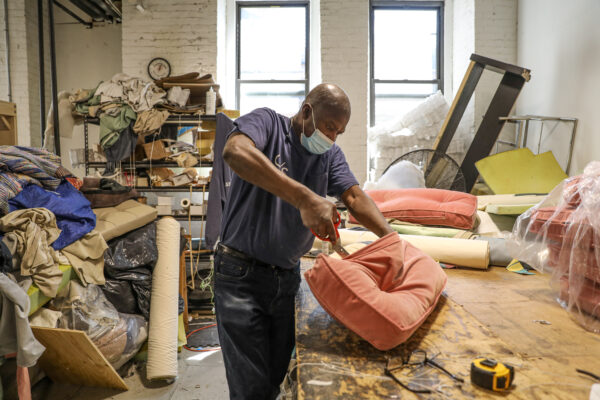
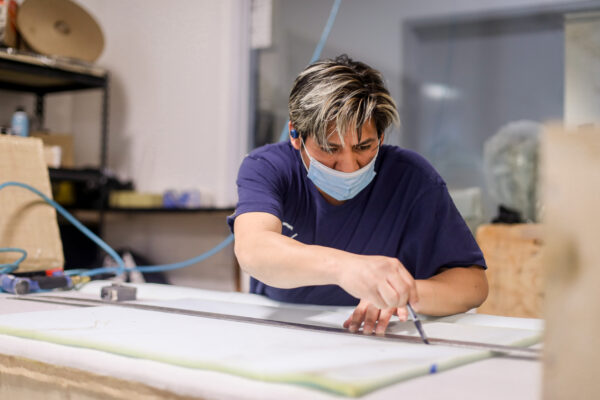
A craftsman working at the Bronx factory of custom furniture maker Classic Sofa, New York City on May 6, 2021. (Sam)A craftsman making measurements at the Bronx factory of custom furniture maker Classic Sofa, New York City on May 6, 2021. (Sam)
Anding has grown the business over the last ten years and has had the pleasure of watching it flourish. The firm has worked with renowned interior designers on high-profile projects—providing upholstery to the Trump SoHo hotel (now The Dominick hotel); sofas and cushions for the rooms in The London NYC hotel (which has since been rebranded a Conrad hotel); and a sofa and loveseat for talk show host Andy Cohen’s Manhattan apartment.
But what the company is most proud of is its quick lead times. After receiving the fabric, it can produce and deliver completed projects in three to four weeks, compared to the average 12 to 16 weeks for competitors. “It’s unheard of in our industry. It’s a very fine-tuned machine because we have the right people working on the projects: getting materials in, for example, so projects get delivered quickly.”
(Courtesy of Classic Sofa)
He mostly works with clients in the tri-state area as well as Florida and California, as the vast majority of his clients have homes in the United States, but he has also shipped furniture to Paris and London. The firm only does 100 percent custom bespoke, from fabric to wooden pieces, for residential and commercial projects. The furniture is bench-made, meaning produced to requested design specifications, and manufactured locally in the Bronx by master craftsmen. “I work in the factory with them to ensure the quality of our products every step of the way,” Anding said.
Before going to the showroom, clients can submit ideas to the company via its website, so when they arrive at the firm’s Manhattan design center, they’ll only need to work with interior designers to determine specific details such as seating dimensions, cushion densities, and fabric selection. Another major selling point is that the company offers a lifetime guarantee on frames and springing.
Clients can request an in-home consultation with a member of Classic Sofa’s design team and get assistance on style, cushion fill, and fabric choice for a new piece or reupholstery for an existing piece. The company also has a whole host of fabric partners, including Brunschwig & Fils, Coraggio, Designtex, Ralph Lauren, and many more. These brands have their own custom furniture collection with Classic Sofa—for the clients who aren’t looking for a fully unique product.
(Courtesy of Classic Sofa)
Uniqueness, though, is Classic Sofa’s specialty. The more challenging the project, the more fun Anding has when transforming clients’ ideas into products. According to Anding, that’s the best part of the job.
“One of my favorite projects was for actress Mary-Louise Parker’s new Brooklyn residence. She wanted a [Vladimir] Kagan-inspired piece but with loose seat cushions for comfort. Most importantly, the piece was oversized, stretching across her entire living room.” Anding needed to trace out a sectional design with the perfect curvature and proportional size to fit the aesthetic and size of the room. The sofa had to be designed and produced in pieces and upholstered onsite.
“Designing bespoke furniture is about understanding your client so you can distill what they see as beautiful into each piece that you make. Most importantly, this is a labor of love, from drafting the initial design, through framing and upholstery, to seeing smiles on client’s faces on delivery,” he said.
Erin Tallman is the editor-in-chief of ArchiExpo e-Magazine, an online news source for architecture and design professionals. She is based in Marseille, France, and enjoys cycling around Europe as a way to soak up the culture, discovering hotel gems along the way.
“Sisu” could well be the favorite word of the Finnish people. The term is loosely defined as “the Finnish art of courage.” It refers to a mix of resilience and perseverance that leads to a life of greater purpose and happiness, and Aune Ylitalo, a second-generation Finn, reflected Sisu in all its strength and beauty. This wonderful woman was my mother.
Mom blessed our world with her arrival on January 20, 1914, a frosty winter morning in the tiny Minnesota village of Floodwood. Aune was nicknamed “Cutie.” “I guess I was nice looking at the time,” she told me. But my mom was always beautiful, inside and out, her entire life.
Aune was welcomed by three siblings and her parents, William and Fina (Makitalo) Ylitalo, who emigrated to the United States around the turn of the century. William came first, finding a place to settle before calling for his young bride, who made the treacherous transatlantic journey by steamer … bringing her Sisu with her! They settled on a small farm and worked hard to raise their family. The simple farmhouse had no electricity or indoor plumbing. Kerosene and Aladdin lamps provided lighting, and two wood stoves warmed the house during the long harsh Minnesota winters. A compartment in the “icebox” held huge blocks of ice that my grandpa took from the river, blocks that were kept frozen in sawdust until they were placed inside.
The “outhouse” was dark and cold, but the saving grace was the good old-fashioned Finnish sauna! After enjoying the intense heat and steam that arose from the hot rocks in the corner, mom and her siblings would run out into the snow, rolling around to “cool off.” The basement also housed a washing machine run by a small gas engine and a “storehouse” for canned goods from the vegetable garden and the jams and jellies made from fruit, fresh-picked during the summer months.
Mom was her mother’s helper, and they did everything together. “The house had to be clean at all times,” mom remembered. They used milk to shine the kitchen floor, and on Saturdays, they freshened all the sheets on the clothesline. Grandma taught mom to cook and how to can vegetables and fruits. They often drove 50 miles just to pick blueberries. Mom loved baking cakes and pies and was sometimes called upon to bake for a family whenever their sons came home from college.
But mom’s favorite task was working with her dad and brothers on the farm. She drove horses and the tractor. She helped in the hayfields and in the barn and admitted, “I often wished I was a boy!” Even after suffering a broken leg while playing broom hockey on the frozen river near their home, she didn’t slow down “because there was always work to do.”
Aune Ylitalo. (Courtesy of Karen Brazas)
But life wasn’t all work and no play. A Sunday afternoon would find Aune and her friends making their own ice cream or going to town for a “real cone” for 5 cents … more expensive than the candy that cost only a penny. In the summer, picnics and swimming in the river were favorite pastimes. “My brothers taught me to swim by throwing me off a boat!” mom said. “I had to either swim or wish I had.”
Holidays at the Ylitalo home were simple. The women spent hours cooking and baking while the men chopped down a tree that would be decorated with simple handmade ornaments. Mom sewed and knitted scarves and mittens as gifts for her family. A sleigh ride was the highlight of the season.
Aune enjoyed school, and since the farm was 4 miles from town, transport was a horse-drawn “school bus” carrying 14 children. “Occasionally all 14 of us had to jump off the carriage so the bus could get ‘unstuck’ from a deep mud hole,” mom said with a smile. During those years, her Finnish Sisu played a big part. Her dreams of attending college and becoming a home economics teacher were foiled when her mother suffered several strokes that required Mom to stay home and manage the household. But she never regretted her decision. “I stayed where I was needed. I would never have had the heart to leave.”
But leaving familiar surroundings would become a theme in her life. Only months after she and her new husband set up their first home, Dad was drafted into the Army, and they left their families behind to move to Florida for his training. Months later when Dad was deployed to India, Mom moved back to the farm, 8 months pregnant with their first child. Dad was gone for almost two years. During their 68 years of marriage, because of Dad’s career, they relocated many times. Each departure was very difficult for Mother, not only because she left behind so many friends, but because she understood the toll each move took on us kids. Once again, her courage and resilience showed through her heartache. Years later, she confessed to me that during each move, she shed her tears in private so none of us would see.
Because above all else, my mother was completely devoted to her family. There was nothing she wouldn’t do for us … preparing home-cooked meals, shopping for school clothes and supplies, helping with homework, warmly welcoming our friends, never missing a school concert or ballgame, cheering us on and encouraging us every step of the way, especially when we were sad, worried, or distressed. “Don’t worry, honey,” she’d say to me. “You’re going to be just fine.” Her balm for an aching heart.
Years passed. Dad retired and they resettled in Arizona. Life became more and more simple as they aged and moved from house to condo and finally to assisted living. Downsizing with each move, mom’s belongings became simple … a few matching outfits, simple holiday decorations, a collection of her favorite romance novels, her treasured family photo albums and framed pictures, a box of age-old greeting cards received through the years, and her trademark White Shoulders perfume.
Throughout her life, her amazing warmth and comfort extended to everyone who knew her, and she had a way of making us children feel courageous, strong, and important. She always assured us that “everything will be all right. Everything will work out.” And whether we were playing cards, watching TV, chatting on the porch swing, curled up reading our books, baking cinnamon bread together, or enjoying our morning coffee, even doing nothing in her company was everything.
Mom passed away quietly at the age of 98. She died in the early morning hours of our 9/11 wedding anniversary. Each year we celebrate our marriage and her life. To say I miss her isn’t enough. To say her death left a hole in my heart isn’t accurate either. Because she left it filled with her kindness, her gentleness, her love, and yes … her Sisu! Because on the days when I wonder how I can go on without her, I feel her loving arms around me and I hear her soothing voice … “Oh honey, don’t worry. You’re going to be just fine.”
Karen Brazas is a retired high school English teacher and creative writing instructor who taught in California, China, and Lithuania. She worked and studied in 35 countries with the Semester at Sea program. Karen is a wife, mother, and grandmother, and now lives in Nevada City, California, and Channel Islands, California.
The 1950s have been referred to as the “Golden Age” in America. Taxes were high, but the economy was strong as was our military. Eisenhower was our President, and folks sported “I Like Ike” lapel pins. But as a child, I was oblivious to it all. I was too busy growing up.
My family moved to a sleepy little town in southern Minnesota when I was six. A population of about 700 farmers and “townies,” primarily Swedes and Norwegians, called this slice of lush green landscape their home. We settled into an old Victorian clapboard “lady” purchased for a whopping $4000 in 1953. Ancient elms bowed low along our street, fragrant lilac bushes graced the front porch, and purple morning glories raced up the telephone pole by the narrow alley that separated us from the schoolyard. Our houses weren’t numbered, and our streets weren’t named. Mail, labeled with only our name and our town, was retrieved at the local post office.
Because it was so big and right near the school, our yard was everyone’s favorite playground. In the summer the neighborhood boys set up residence in a treehouse in the towering old pine where they hid their collections of Superman, Batman, and Captain Marvel comic books from their parents. We girls “played house” in a sheet tent set up over the clothesline. We ran through sprinklers, played kitten-ball and croquet, swirled our hula hoops, and tossed frisbees. And a few of my lucky friends whipped through the neighborhood on their newly popular Schwinn bicycles. In the winter we built snowmen and igloos, and we ice-skated long into the evening. In the summer we’d spend hours at the school playground, catching tadpoles at the creek, and capturing fireflies in jars at night. We were always outside—day and night, rain, shine, or snow.
When we did come inside, we rarely used the heavy front door that led to a cold, imposing front foyer, the perfect spot in the heat of the summer for an uninterrupted game of jacks, Candyland, or Chutes and Ladders. The only folks who used that door were the milkman, the women of the Ladies Aid when mom hosted, the doctor who made house calls, or our minister paying us his yearly visit.
The foyer led to the living room, the home’s original dining room. Our black and white TV with only one channel sat in the corner. But the acquisition of that appliance was a huge event! I rarely missed “The Mickey Mouse Club,” and “Tom and Jerry” and “Bugs Bunny” cartoons were my little brother’s favorites. At suppertime we patiently waited as Walter Cronkite reported the evening news—news of Rosa Parks, Martin Luther King Jr., the Korean War, or the Soviet’s Sputnik blasting into outer space would only interest us years later. My favorites shows were “American Bandstand” and “Hit Parade,” a treat on Saturday night once I finished my Sunday School lesson. My parents, however, drew the line when Elvis appeared on the Ed Sullivan show, pronouncing his classic moves in “Jailhouse Rock” as “inappropriate.” My mother seldom missed “I Love Lucy” and “Father Knows Best,” and my dad seldom missed “The $64,000 Question.”
My sister and I shared a tiny bedroom, home to our Nancy Drew Mystery collection and our Betsy McCall paper dolls that we clipped from mom’s monthly magazine. The Everly Brothers’ “Bye Bye Love” and Ricky Nelson’s “Poor Little Fool” provided music on our little ’45 record player.
My brother’s bedroom was the home’s original pantry, a space just large enough for his bed, which was next to a door that led to a cold dark basement with an earthen floor. (My poor little brother … I knew that whatever ascended the old wood stairs at night would get him first!)
The kitchen was the hub of activity year round for us and our friends. After spending hours at the playground or the ice rink, we’d all tromp into that big warm kitchen for Spam sandwiches and hot cocoa. A cast iron radiator warmed our soggy mittens and earmuffs while keeping my shoebox of baby kittens warm. An old wooden wall phone hung in the corner. We were on a “party line” with one or more neighbors which allowed anyone to listen in on our conversations!
A spacious bathroom, once the “scullery,” was big enough for a sink, a commode, a “bathtub built for two,” an ironing board, and a washing machine. There were no clothes dryers, so laundry was hung outside. No one believed Robert Frost’s “Fences make good neighbors,” so no barriers separated our wide grassy yards. Housewives chatted while hanging the laundry. Kids chased balls through neighbors’ yards. Dogs roamed freely, and backyard BBQs were “come one, come all.”
Everyone knew pretty much everyone else in town, and neighbors helped raise each other’s children. We got away with little as the self-proclaimed “neighborhood watch” was ever vigilant. This was fine with us as we could always count on a warm cookie and a glass of milk wherever we went. Any neighborhood in town was “our oyster.” We never worried about crime, abductions, or getting lost. Our parents never thought to accompany us as we meandered down our dark streets on Halloween collecting homemade cookies and popcorn balls all over town.
Holidays were also exciting community affairs. Memorial Day and the Fourth of July would find most everyone in town grilling hotdogs and roasting marshmallows at Sportsman’s Park. Church suppers were popular at Thanksgiving, and carolers strolled through dark snowy streets at Christmas.
Even if their children weren’t involved, most adults attended school concerts, plays, ceremonies, and ball games. In the fall, hay wagons were offered up so each class could construct a float for the homecoming parade. And the entire town gathered for the traditional bonfire where we would lead cheers, crown the king and queen, and burn our opponent in effigy. That event, like so many others, created an atmosphere of support, of inclusion, and of joy.
All the businesses in our town were located on one main street. We kids hung out at the drug store, perched on wiggly red plastic stools, sipping cherry sodas through red licorice sticks. Our little movie theater was occasionally open showing hits like “Singing in the Rain,” “Peter Pan,” and “Rebel Without a Cause.” A small popcorn stand next door offered up a hot buttered treat on the way home from the indoor roller rink where we spent our Friday nights roller skating or attending sock hops, showing off our new poodle skirts and dancing the twist and the mashed potato. “Cruising” was the favorite pastime for the teenagers … up and down the main street for hours, often ending up at the drive-in movie or chatting with the car-hops at the A&W root beer stand.
Over the years, I’ve returned to my “roots,” and I realize how time marches on. My house, which I remember as quite imposing, looked rather forlorn. Its front porch sagged, and weeds grew where lilac bushes once flourished. Streets are now named, and a street light hangs over Main Street. The school playground was empty except for a few children playing under the watchful eye of a parent. Yards were separated by fences, and few people were about.
Thomas Wolfe said, “You can’t go home again.” Perhaps I should have heeded his advice. But I know that years can’t erase my precious past. And now it’s my turn to create memories for my own grandchildren so that when they look back on their childhoods, their memories will be as happy as mine.
Karen Brazas is a retired high school English teacher and creative writing instructor who taught in California, China, and Lithuania. She worked and studied in 35 countries with the Semester at Sea program. Karen is a wife, mother, and grandmother, and now lives in Nevada City, California, and Channel Islands, California.
I promised myself long ago that if I were ever lucky enough to have grandchildren, I would be the best grandmother! I would read to them, sing to them, take them to wonderful places, and teach them all about life. Little did I know that they would be the ones teaching me.
Mia and Tyler marvel at the world around them, whether it’s a seagull flying high above the beach, or a deer or fox at the forest feeder, gobbling up tasty leftovers. They take great delight in watching these beautiful creatures. When the first snowflakes fell, little Tyler ventured outside and glanced skyward. A look of astonishment crossed his face, but before long he was twirling in circles and squealing with delight. The first time Mia experienced rain, she was mesmerized. Her little fingers reached out and seemed to caress the raindrops, her little nose pressed tightly against the cool damp windowpane. Neither child minds the rain, and actually looks forward to a storm because, as Mia says, “I know there might be a rainbow!”
(Revel in nature’s beauty, and even when it’s familiar, never take it for granted.)
Mia and the sea turtle. (Courtesy of Karen Brazas)
The children like trees and rocks and even pretty weeds. They’re never in too much of a hurry to “stop and smell the roses.” A tiny blossom, a little feather, a shell on the beach, or even a “perfect stick” is special. On our walks, they take delight in a passing dog, a stray cat, or a garden lizard. Tyler is ever on the lookout for fire engines, police cars, and passing trains.
When these two aren’t looking around, they’re looking up … at beautiful fluffy clouds, debating which animal they look like.
(Look around. Take the time to appreciate everything in your world.)
(Courtesy of Karen Brazas)
My little ones study people and gravitate toward those who are nice and friendly. They aren’t afraid to make new friends, and while playing in a park, Mia will go up to a random child and ask, “Do you want to be my friend today?” From his balcony or bedroom window, Tyler calls out to greet passers-by whether he knows them or not. And if either one is rebuffed, they aren’t bothered. They simply engage with someone else.
(Never take yourself too seriously. Sometimes you just have to move on.)
Mia’s first rainfall. (Courtesy of Karen Brazas)
Before they could even walk, they couldn’t wait to venture out into the pounding surf, crawling like baby turtles, straight to the sea. And now they both charge full speed ahead to meet the waves, unaware of what they might be getting themselves into. As toddlers, they were afraid to cross over the three-inch gap leading into our home elevator and would wait for me to lift them across. I remember the day Mia studied that gap and then scurried over it! Once inside, she turned to me with the biggest grin, cheered herself with a big “yay,” and gave herself a hearty round of applause. These days after building up their courage at the park, they aren’t afraid to take chances. They’d climb the highest monkey bars or ride the zip line, their fear dissipating after the first try.
(“Sometimes the only method of transportation is a leap of faith.”)
(Courtesy of Karen Brazas)
These two are ever eager to try new tasks. Never mind the results. Mia insists on pulling weeds, deadheading flowers, or watering pots in my garden. Both she and her cousin love helping in the kitchen, stirring, baking, or dipping strawberries into creamy chocolate. They want to learn how things are done and “Please! Let me try!” is their mantra. Both have mastered bicycle riding, without training wheels. Tumble after tumble, scraped knees and all, nothing diminished their enthusiasm. Now they’re learning to swim, jumping headlong into their daddies’ arms and then attempting to reach the pool’s edge on their own. I can’t remember a time when either one has said, “I don’t think I can do that.”
(Never quit. Never stop learning. Have faith in yourself.)
(Courtesy of Karen Brazas)
If the children try new food and dislike it, they let me know. They feel free (very free!) to tell me where they want to go … the park, the beach, McDonald’s … and what they want to do (which rarely involves school work!)
Even if they don’t know all the words to a song, they sing out loud no matter who is listening. They dance like everyone is watching. If they’re sad, they tell me, ask for a hug, and then reach for a favorite toy or blanket for comfort.
(Say no to things you don’t want, and do what makes your heart happy.)
(Courtesy of Karen Brazas)
Mia and Tyler have learned to be very flexible. Their activities, meals, and bedtimes often depend on their parents’ busy schedules. Some days, they are popped in and out of car seats and shopping carts several times a day. When they travel, a change in routine, unfamiliar surroundings, and sleeping in a different bed doesn’t bother them. They’re aware that tomorrow might be completely different from today. No matter.
(Get some sleep. Tomorrow will take care of itself.)
Tyler seeing snow. (Courtesy of Karen Brazas)
My grandchildren are only 5 and 6 years old. Unlike mine, their skin is tight and smooth. Their hair is silky and shiny. They have energy to burn while my flame often smolders. But none of this makes any difference to them. They sense the gentleness in my heart and see the love in my eyes. They look past the wrinkles and the gray and love me just the way I am. I know, because they tell me so many times a day. They are the essence of unconditional love.
(Tell your loved ones you love them every chance you get … and love them with everything you have.)
I have much to learn.
Karen Brazas is a retired high school English teacher and creative writing instructor who taught in California, China, and Lithuania. She worked and studied in 35 countries with the Semester at Sea program. Karen is a wife, mother, and grandmother, and now lives in Nevada City, California, and Channel Islands, California.
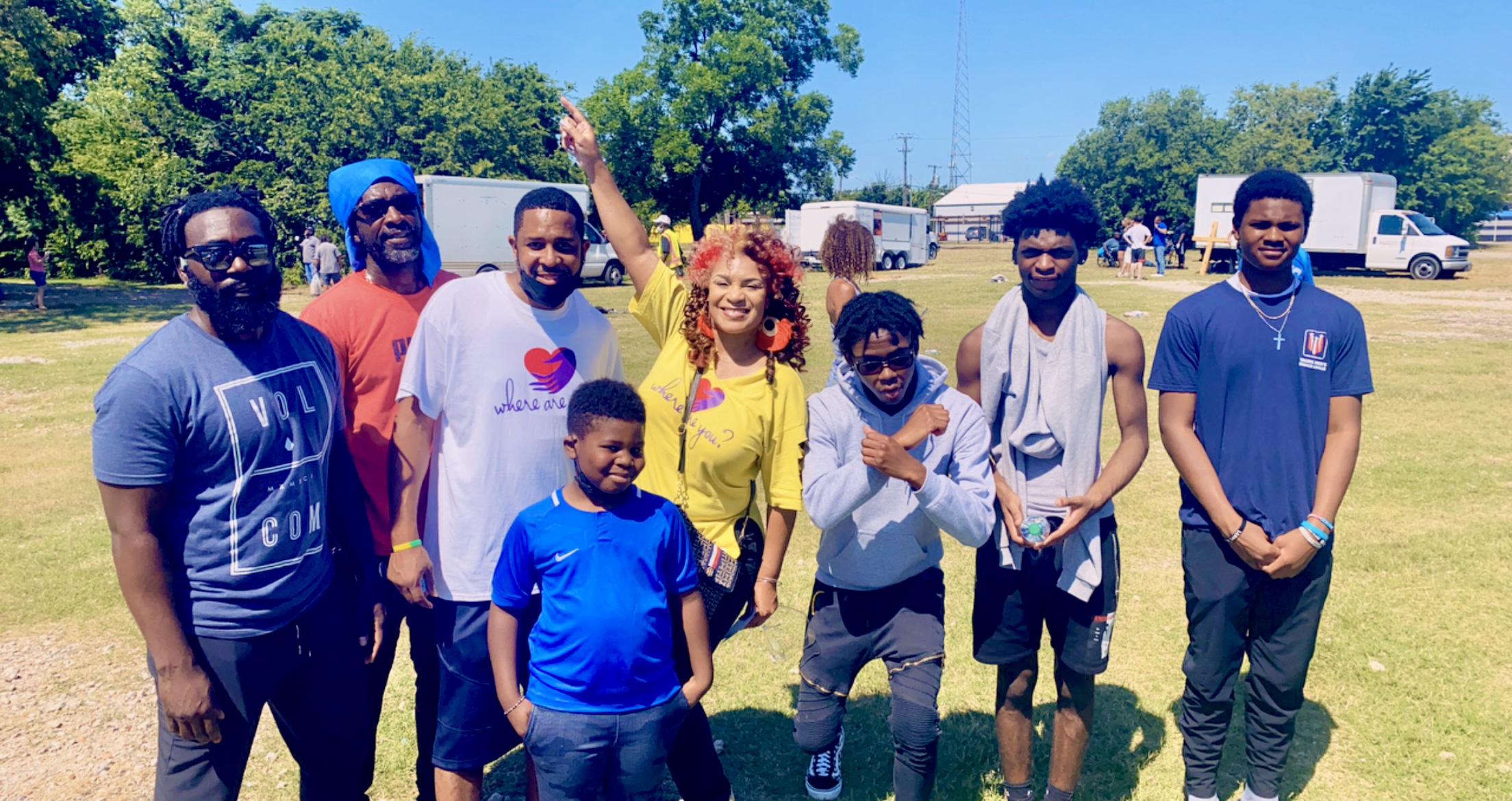
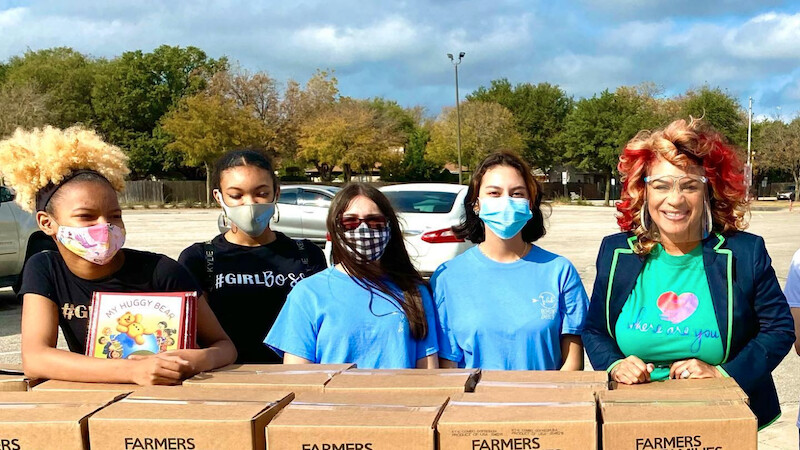
Owens at an event she hosted with two clients she assisted. (Courtesy of LeTitia Owens)
When LeTitia Owens relocated to Atlanta, she thought it was to pursue a singing career. Instead, she unexpectedly became homeless and began living out of her car. “Because I was in my car, I had a certain calm about it,” Owens said. “I knew I could lock my car doors at night and feel secure but I would see families on the street and wonder how can they deal mentally with not having a secure place to sleep at night?”
The experience, which lasted three months, opened her eyes to a world she hadn’t previously noticed.
“I’m looking out of the windows of my car, seeing people pushing baskets and carrying a backpack or a trash bag full of their belongings,” Owens said in an interview. “I wondered what they were doing out at 3 and 4 in the morning not realizing that I was in the same situation except I had a car to sleep in.”
The singer-songwriter began cultivating relationships with other homeless people in order to learn how to survive.
“I felt that as long as my things were with me in my car, I didn’t mentally feel like I was in a negative situation but of course I was trying to figure out what my day-to-day was going to look like,” she said.
When it came time to shower, Owens disclosed that she would befriend people and ask to use their bathroom.
“Once they let me in, I would tell them that I needed to take a shower or I would go to the YMCA or different gyms,” she said. “I found ways to make a shower happen but it’s a tough situation to be in overall.”
Eventually, a friend offered her a couch to sleep on and from there she moved back to Dallas for a job.”
“It’s an extreme measure to move into a shelter and it’s usually because they’re not so nice,” she said. “They don’t have a warm feeling. You don’t feel at home when you’re at a shelter with a bunch of people who are strangers.”
Owens was so touched by the unsheltered people she met on the streets that once she was back on her feet, she founded a nonprofit 501(3)(c) called Where Are You? Outreach (WAYO). Through WAYO, Owens invites the unsheltered to events she hosts twice a month where information about finding food, shelter, bathrooms and fuel are shared.
“We also provide food, clothing, toiletry items and a lot of my homeless men are shoeless, so I get their shoe size and provide them with shoes,” she said.
Last year, the singer-songwriter was nominated by Councilman Casey Thomas II to serve as vice chair on the Citizen Homeless Commission for the City of Dallas.
“It is a volunteer position that takes up about six hours a week,” she said. “You just have to have a heart for those that you’re serving. We have different Zoom calls that we get together on sometimes two or three times a month.”
On August 21, Owens will be giving away housing vouchers for temporary housing in apartments and hotels along with Dallas Councilman Tennell Atkins from District 8.
Recently, according to media reports, the city of Dallas received $21 million in federal funds through the American Rescue Plan Act, and Owens is applying for funding from that pool to acquire a building that would create housing exclusively for African American men who make up the largest homelessness demographic nationwide.
“If we could help homeless Black men, we could help lower the number of homeless people overall,” she said. “It’s usually having to do with getting jobs and just having an income to provide for themselves.”
Owens with volunteers and a few clients she is assisting.(Courtesy of LeTitia Owens)
About 30 percent of homeless black men are military veterans, according to the U.S. Department of Veteran Affairs.
“One of the things that the Citizen Homeless Commission is able to do is assist with recommending who should receive funding because there are so many areas that don’t necessarily get the support they need,” Owens said.
The WAYO office is currently at 5057 Keller Springs Road in Addison but the headquarters will soon be relocating to a larger space in the Jacksonville area so that Owens can offer more services on site to people who are experiencing homelessness.
“I want to be able to provide resources on a regular basis because right now I have to do pop-up shops at different organizations, parking lots and churches,” she added.
“I rent chairs, tables, provide food and if I’m not able to get these resources from my sponsors, then I have to buy all those things,” she said. “It adds up.”
Owens with volunteers at an event she hosts twice a month. (Courtesy of LeTitia Owens)
Juliette Fairley is a graduate of Columbia University’s Graduate School of Journalism. Born in Chateauroux, France, and raised outside of Lackland Air Force Base in Texas, Juliette is a well-adjusted military brat who now lives in Manhattan. She has written for The New York Times, The Wall Street Journal, TheStreet, Time magazine, the Chicago City Wire, the Austin-American Statesman, and many other publications across the country.
Laurie Dorr runs the Finally Home Senior Dog Rescue and Retirement Home in North Yarmouth, Maine. (Peter Falkenberg Brown)
Sally was a Dutch Shepherd dog who arrived at Laurie Dorr’s Finally Home Senior Dog Rescue and Retirement Home in North Yarmouth, Maine, in 2019. Her owner was moving and was unable to keep her. At age 14, Sally would have been destined to live in a cage at a shelter, but the owner found Laurie’s rescue service instead.
Laurie remembers sleeping on the living room couch, with Sally lying on a dog bed next to her, keeping her company for five days until the dog could readjust to her new home. “Sally cried all night because she was away from her owner,” Laurie said. “Sally slept on the floor, right there, and I slept on the couch. I had my arm on her for part of the night. She was very sad.”
Sally passed away a year later, but Laurie helped make her last year a happy one. Finally Home has eight dogs now, most of them between 11 and 14. There are labradors, coonhounds, a diminutive Jack Russel terrier, and even an Australian Shepherd.
Laurie Dorr was raised in Falmouth, Maine, and has had a passionate sympathy for elderly dogs since she was a child. Sometime around the age of 12, she decided that one day she would take care of dogs during the last years of their life—a time when too many of them are abandoned by their owners.
In 2019, she took the leap and started Finally Home from her spacious saltbox house in North Yarmouth. The dogs live in the house and roam freely, from floor to dog bed to couch and then to their fenced-in section of her yard. They even have their own above-ground swimming pool.
Laurie Dorr takes in elderly dogs and gives them a home. (Peter Falkenberg Brown)
Dorr is working hard to raise money to add a new room for the dogs to the house and increase her canine residents to a maximum of 12. She emphasized that she’s not running a typical shelter, where the animals stay in crates most of the time. Finally Home really is their home, and for that reason, she’s limiting the growth of the venture, even though she receives more than 50 requests per year to take in more dogs.
The money that Dorr raises goes entirely to the support of the dogs. She has established a 501(c)3, tax-exempt nonprofit and has gained the support of local banks and individuals. She takes no salary and supports herself as a professional proofreader, with added income from her husband Bob’s position at Bath Iron Works.
Taking care of elderly dogs is an expensive process. Between vet bills, medications, food, and accouterments, Finally Home’s budget is around $12,000 per year. After expanding to 12 dogs, Dorr calculates that expenditures will increase to $20,000 annually. The extra room for the dogs may come at a cost as high as $50,000 due to rising construction costs.
One of her goals is to raise enough money for Finally Home to give grants to owners of elderly dogs so that they can pay for each dog’s medical bills—and allow the owners to keep them. Many dog owners can’t afford the hefty vet bills incurred by older dogs at the end of their lives and are thus forced to take the pets to animal shelters.
In spite of the need for constant fundraising, Dorr is optimistic and intensely grateful for the opportunity to love a dozen old dogs who might otherwise be staring at the inside of a cage. She loves her dogs, and as I watched them greet me at the gate with tails wagging at the sight of the treats in my hand, I could tell that her brood of canines loves her too.
Peter Falkenberg Brown is a writer, author, and public speaker. One of his recent books is titled “Waking Up Dead and Confused Is a Terrible Thing: Stories of Love, Life, Death, and Redemption.” He hosts a video and podcast channel called “Love, Freedom, & the World” at his website PeterFalkenbergBrown.com.
The wilds are returning to Eastern Kentucky in what could be called a triumphal environmental story. Sportsmen license fees and private funding have been the backbone of conservation and restoration efforts, and even cultural awareness is increasing. (Chris Musgrave)
The past 20-plus years of mass media reporting on the environment has been dominated by predictions of cataclysmic catastrophe and mayhem, although during my life, I’ve seen a very different story.
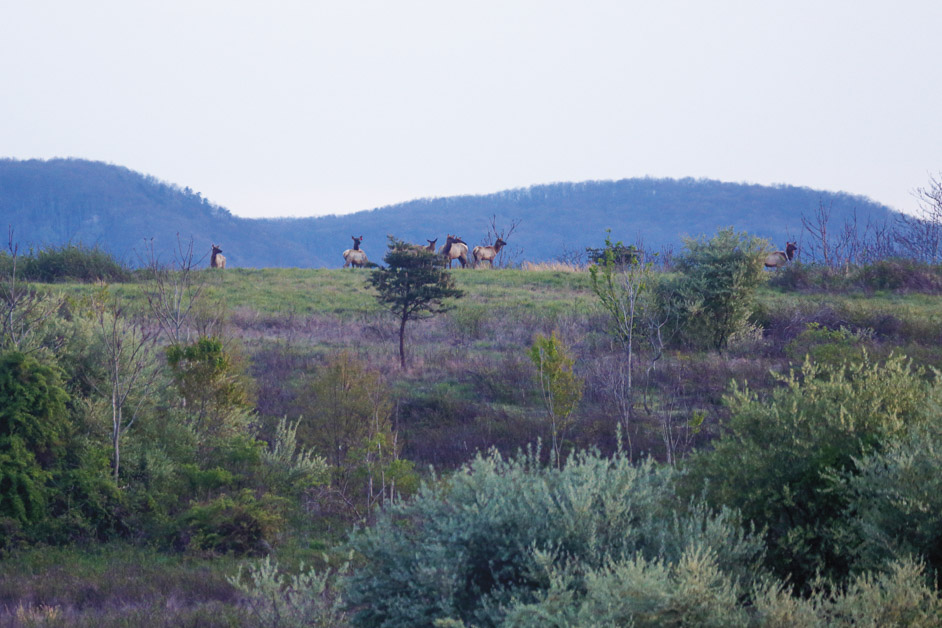
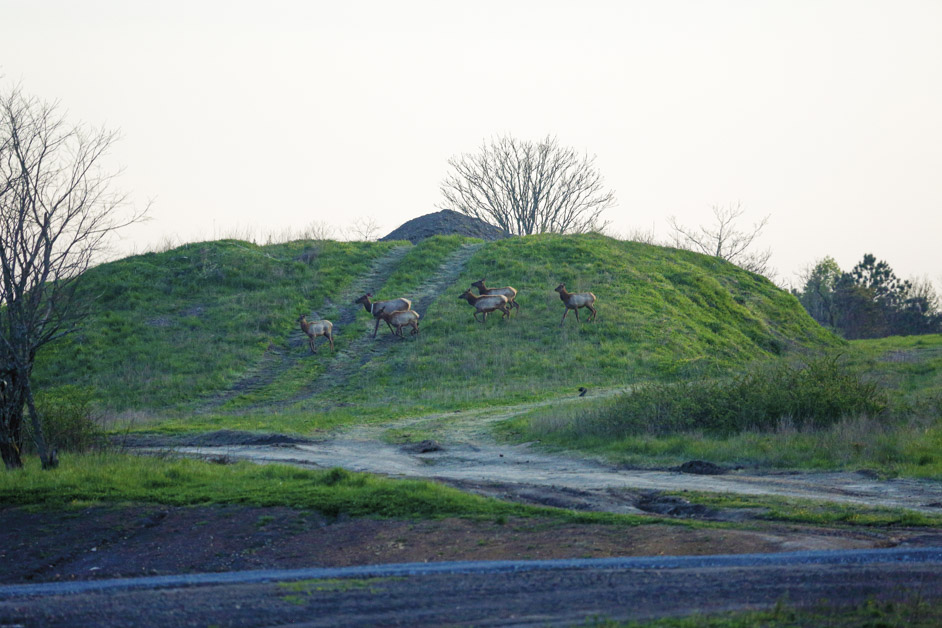
Growing up in Eastern Kentucky, deer were few, with no bear, coyotes, turkeys, mountain lions, bald eagles, and certainly no elk. Today, all of these species are present again. Positive things are happening. Wildlife is naturally returning and many species are rebounding with streams cleaner than they’ve been in decades.
Elk enjoying a reclaimed surface coal mine in Martin County, Ky., on Aug. 20, 2015. (Chris Musgrave)
How can this be? For years, doomsayers have warned about the end of nature if we didn’t turn the American way of life on its head; they may find it ironic that capitalism funds the successful environmental protections that we do have.
Recently, I took my family to the Salato Wildlife Center in Frankfort, Kentucky. Throughout that gem, you can find the answers of how this can be.
Blight and Restoration
How did the dearth of nature come to be in the first place?
At the turn of the century, the chestnut blight in the eastern part of the country—where strong, rot-resistant chestnut trees that grew since time immemorial fell in mere decades—along with irresponsible clear-cut logging led to ancient forest floors in the mountains to be washed out. The ecology, flora and fauna, and economies tied to chestnuts were devastated. The old-growth forests are now lost except for small pockets such as in Blanton Forest in Harlan County.
(Daniel Ulrich)(Daniel Ulrich)
At the same time, many wildlife populations crashed due to overhunting and habitat loss. The Great Depression caused remaining species such as deer, rabbits, and squirrels to be hunted for food, with no regard for conservation as people struggled to survive and feed their families. As the Depression ended and most places prospered, much of Appalachia remained impoverished.
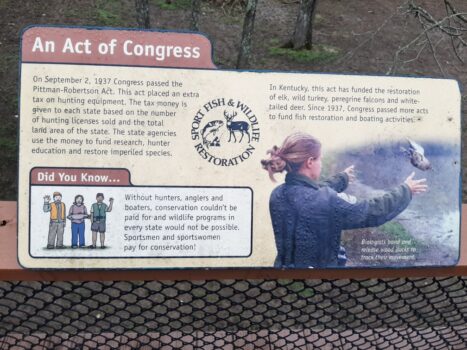
Hunting and fishing licenses are the backbone of conservation and restoration efforts. Hunters funded the successful reestablishment of elk, to the point that we now have regular seasons for hunting.
An active coal temple in Pike County, Ky., on Aug. 10, 2011. (Chris Musgrave)The reclaimed mine of Bell County, Ky., an Appalachian Wildlife Foundation location, on July 22, 2014. (Chris Musgrave)
Bad actors of the past made the Surface Mine Reclamation Act necessary. If you’re unfamiliar with the industry, you may be surprised to learn that reclaiming is part of the regular process, and typically leaves the land better than before it was mined. Why? Because that original land would have washed out about 100 years ago when the chestnut blight ravaged the forest (the restoration of the American chestnut is a subject for another story).
Elk enjoying a reclaimed surface coal mine in Martin County, Ky., on Aug. 20, 2015. It’s this grassland that they like. (Chris Musgrave)(Daniel Ulrich)(Daniel Ulrich)
Now, drainage controls are engineered, preventing washout. Native grasses are planted along with nut-bearing trees to promote wildlife. Within a few years, what started out like a scene from “Mad Max Beyond Thunder Dome” is a lush paradise that supports diverse wildlife.
No better example can be found than that of the privately held Appalachian Wildlife Foundation. It’s in the final stages of building a public educational research station, located in Bell County, Kentucky, where the first mountaintop removal mining site in the United States is. People unfamiliar with the reclamation process have no idea it was mined, and the elk couldn’t care less.
Modern-day surface mining is like making sausage: The process is not pretty but the end result is great. The location of the wildlife foundation several decades ago more resembled the surface of Mars or the moon as the top of the mountain was removed of the overburden in order to reach the valuable coal seams below. When coal is too close to the surface, the ground is not stable and it’s not safe to mine underground. To access this coal, the ground above must first be removed.
(Daniel Ulrich)
It is only fitting this wildlife sanctuary was once paraded by those opposed to mining as an example of how awful mining is, because active mining is ugly. This short-sighted view ignored the big picture and the responsible and forward-thinking stewardship by the landowners. When mining was first completed and the reclamation process started, the first few years the land was home to only grasses and low brush and briers taking hold. After a few years and seasons, the soil develops as vegetation decays returning to soil. Per the requirements based on extensive research, the soil is only compacted to certain point to prevent run-off, but not so tight as to prevent trees from easily re-establishing, (early reclamation law required soil be very compacted, inadvertently thwarting vegetation, and thus wildlife returning).
Today most people wouldn’t know Boone’s Ridge was a mine, (with limited active mining still occurring). This is true of most surface mining today, as only contour mining is permitted, where the peak must remain and only the outer edge of a coal seam is mined creating a bench. This bench is filled post-mining and the mountain is returned to its original contours. Once these location are covered with significant hardwood trees, they are indistinguishable from other parts of the hillside not mined to the untrained eye.
Education Works
The many creeks and streams in the region were once clogged with decades of trash and sewage from straight pipes.
Today efforts by private volunteer groups such as PRIDE (Personal Responsibility In a Desirable Environment) remove trash from the streams every April. Over the past decades, septic tanks and new sewage treatment plants have almost ended raw sewage discharge. As a result, fish and aquatic species are flourishing, and even beavers and river otters are returning.
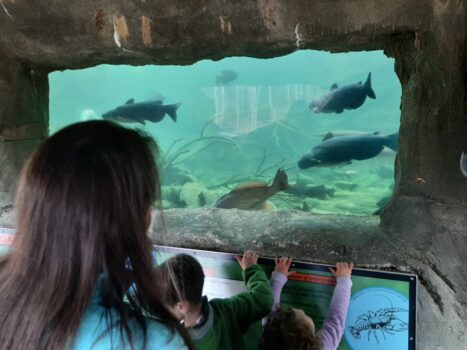
The Salato Wildlife Center in Frankfort, Ky. (Chris Musgrave)
I currently serve on the board of the Kentucky Environmental Education Council, which has played a key part in cultural change for the last several decades by exposing Kentucky students to environmental issues and terms.
Yet another factor changing culture is simply time: The outlaw hardscrabble poacher culture borne of desperate times of the Great Depression has to a large degree died out or become too old and feeble to do much harm. Less fortunate segments of society now have social safety nets and improved infrastructure making it easier to meet basic needs unavailable in the past.
This certainly has helped remove the pressure of necessity to subsist. Most sportsmen today buy licenses and make good faith efforts to follow the seasons, limits, and regulations.
The Salato Wildlife Center in Frankfort, Ky. (Chris Musgrave)
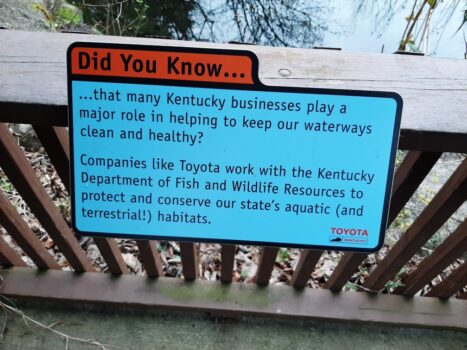
Private corporations can play a role as well, often the ones contributing to funds that make much-needed conservation efforts possible.
The Salato Wildlife Center in Frankfort, Ky. (Chris Musgrave)
Having studied the history of energy and environmental law and being a sportsman myself, I’ve heard much blaming of corporations, industry, and hunters of today for the harms of the past. Education has helped dispel some of these misconceptions. And yes, we do have some real environmental problems in this world; most have root causes traceable to the desperation of poverty, corrupt systems of government, or ignorance of the harm of our actions.
For example, when the Soviet Union collapsed, desperation and anarchy nearly wiped out caviar sturgeon in Russia. Corruption happens, too. Recently, when a mine in Pike County started receiving complaints from surrounding neighbors, it turned out the federal mine inspector was accepting bribes to not enforce the law. Once discovered, it was stopped and the inspector and operator are now in jail. Ignorance of the consequences of actions factors into these environmental problems. Take the example of DDT pesticides; once the harm was discovered, regulations caught up and banned its use.
The wilds are returning to Eastern Kentucky in what could be called a triumphal environmental story. Sportsmen license fees and private funding have been the backbone of conservation and restoration efforts, and even cultural awareness is increasing. (Chris Musgrave)
I saw a wild bald eagle about seven miles from Lexington, Kentucky, just last week. Last summer, a black bear was spotted downtown near a University of Kentucky hospital. These occurrences were unthinkable 30 years ago.
Chris Musgrave is a Kentucky attorney, farmer, and policy professional in energy, environment, agriculture, education, elections, history, and government administration and affairs. He enjoys hunting, fishing, and writing music and articles for fun. He is also a board member of the Kentucky Environmental Education Council and Historic Preservation Review Boards.
Paul Raci, nominated for best actor in a supporting role for "Sound of Metal", at the EE British Academy Film Awards 2021 on April 11 in Los Angeles. (Rich Fury/Getty Images for ABA)
“I didn’t realize it at first, but it slowly dawned on me that I had been rehearsing for this role my entire life,” says actor, singer, and performer Paul Raci. “Being a CODA (child of deaf adults), my whole life has been spent working with the deaf community, especially my parents.”
“I only wish they could be here to see this,” said an emotional Raci.
Raci was recently nominated for an Academy Award in his role as Joe in the film “Sound of Metal”—a departure from his usual television spots here and there..
“I worried and wondered if I could handle a role of this magnitude,” says Raci of his role as Joe, the “late-deafened” Vietnam veteran and alcohol counselor.
But as Raci wrestled with the role, he realized his life’s story was Joe’s story.
“My father was born deaf and was a proud member of the NAD (National Association of the Deaf) as was my mother, who was deaf from about the age of 5. I saw the setbacks, the frustration, the taunting, and the bullying,” he said. As a child, I watched my mother, a most studious woman, who was an expert lip-reader. I mimicked many of her movements for the role. I myself suffer from bouts of tinnitus from my time in Vietnam, as did many of my brothers who worked on the flight deck with me. They gave us a piece of cardboard as hearing protection. Many of those guys are fully deaf now, so this role was me—it literally mirrored my life.”
The Role
Actor Riz Ahmed (“Shifty,” “Four Lions,” “Nightcrawler”) portrays a heroin-addicted heavy metal drummer who’s going deaf after refusing to protect his ears and who is struggling to keep “clean.” His girlfriend, portrayed by actress Olivia Cooke (“Thoroughbreds,” “Ready Player One”), fearing a relapse, sends him to a deaf-sober house. It’s at this point that Raci makes his entrance.
“Riz’s sponsor finds a deaf-sober house run strictly for the deaf community, which was founded by, and run by my character, a Vietnam vet who is deaf from the war and who is also an alcoholic,” Raci said. The script originally called for Raci’s character to have been an Iraqi war veteran, but in a request designed to help him give as authentic a portrayal as possible, Raci asked that the character mirror his real-life service in Vietnam. “It really made the part come alive for me.”
“I thought about my parents all through this,” Raci added. “And I thought about all the wonderful deaf people I had known growing up.”
“I just hope I honored them all,” he said.
Paul Raci, nominated for best actor in a supporting role for “Sound of Metal”, at the EE British Academy Film Awards 2021 on April 11 in Los Angeles. (Rich Fury/Getty Images for ABA)
Real People
Raci says that he is sensitive to the needs of the deaf community.
“I had to be the conduit for my dad. I saw the way hearing people treated him. My father always felt oppressed. I was the one who had to negotiate contracts, even as a little kid. If this role was that of a person fully deaf from birth, as my father had been, do you think that I could have given this same kind of performance? I couldn’t have taken that role, it would’t have been me. It wouldn’t have rung true,” he said. “But this was my life.”
Paul Raci explains the part of Joe. (Courtesy of Paul Raci)
You might think that a role which doesn’t spotlight the positive side of the deaf culture might have offended Raci. You’d be wrong.
“See, that’s the thing—that’s the thing that this movie is going to show you,” he said. “The world thinks about how deaf people are just the sweetest people. They’re so quiet. They wouldn’t rape anybody, they wouldn’t break a law … or smoke anything bad … or do drugs. But we’re people, like anyone else. And that’s what drew me to this role. These are real people. This shows you a recovery house with about 12 hardcore addicts who are deaf—and addicted,” he said.
Raci says he’d rarely seen the deaf portrayed as it was,warts and all, until he read this script.
“The deaf are addicts, they’re lawyers, they’re accountants, they’re good people and bad people,” he said.
(Courtesy of Amazon)
Raci’s Arrival
Raci is always looking for ways to introduce the deaf culture to new audiences, which is what attracted him to the band, “Hands of Doom,” a “Black Sabbath tribute band,” where he performs what the band calls “ASL (American Sign Language) Rock.”
Hands of Doom. (Courtesy of Paul Raci)
“I act out each song, and that really makes each song come alive, especially for the deaf community,” he said. The band has gained a strong following among the deaf community and Black Sabbath fans the world over. “I try and bring my experiences and my growing up with deaf parents, into every performance.”
Raci’s family has seen his band, and his turn in “Sound of Metal.” And they approve.
“My family has seen it, and they’re really happy with it. They knew it was real, and from the heart,” he said. “Especially the ending.”
While Raci has been acting for more than four decades, he says he’s been waiting for this role his entire life.
(Courtesy of Paul Raci)
“This role? Man, you have no idea. I’ve been acting for 40 years. I’ve got damned good acting chops. I came out here in 1989. I’ve done plenty of theater … but I’ve never gotten a big role in a movie, just bit parts. I’m 72 years old. I’ve been doing this 41 years.,” he said. They offered this part to Robert Duvall, but thankfully, he didn’t want to learning language.
They shopped it around. They wanted a “name” attached to it, and “Paul Raci” wasn’t a name.
“My agent, who’s also my wife, actually called them and begged them to look at my audition. She said, ‘Did you look at his audition?’ They said, ‘You know what? We’ve had so many people audition for this part … we’re just going to give it to a name.’ They said that. They actually said that!” said an incredulous Raci.
Not to be denied, Raci’s wife called the producers one last time and begged them to look at the screen test. She said, “Please, please, look at this tape, because this guy knows what he’s doing.”
Minutes later, Raci got the call every actor dreams of.
“They called me back five minutes later. The director said, we want to meet him right away.” Producers offered Raci the role right there on the spot.
“And now … if you’re a character actor too, you know, and so does every other day player in this town …I ’m going to be up for best supporting actor. Me! 41 years I’m doing this,” Raci said. “I’m being nominated for best supporting actor for this thing, because I kicked butt!”
“Everybody, and I mean everybody talks about the last scene. A few months ago, there was the press junket: I did 40 interviews of four minutes each: CNN, CBS, NBC, Phoenix stations, Minnesota, New York … and they were all asking, ‘How’d you do that…that last scene?’”
Raci credits director Darius Marder with allowing him to find the role within himself.
“Darius Marder, this was his first directing effort, although he wrote “Beyond the Pines,” and “Loot” and he was just awesome as a director. He’s sensitive, he’s wonderful, he’s smart. He let me do what I had to do. We talked about what he wanted from me. And after that last scene, I looked over and Darius was just weeping. I mean weeping. Riz and I laugh about it now … but it’s about two grown men being vulnerable. One reviewer in Toronto said, ‘I wanted to stop the movie because I wanted to see if the actors were ok.’”
The final scene should come with a “spoiler alert” to keep tissues handy. “I’ve had dozens of people ask me, ‘What about that last scene?’ One writer from The Chicago Tribune asked me about the last scene … he wanted to know how it was accomplished. He said, ‘You can’t teach that kind of acting can you?’ And I said, ‘No, no you can’t. I was made for this. Now, could I have done that scene 40 years ago? No. But now? That’s my whole life in that role … and it’s all in that last scene. Now people want to know where I’ve been,” he said with a laugh.
Where Paul Raci has been is waiting for a role like this his entire life. If the stars align and the portrayal is seen by enough of the right people, Raci knows exactly where he’ll be next: “The words ‘Academy Award winner Paul Raci,’ have a nice ring to them,” he said. “I like the sound of that.”
Paul Raci, nominated for best actor in a supporting role for “Sound of Metal”, at the EE British Academy Film Awards 2021 on April 11 in Los Angeles. (Rich Fury/Getty Images for ABA)
Pianist and composer Eric Genuis has played nearly 1,000 concerts in prisons, including hundreds in youth prisons. (Kirsten Butler Photography)
There was a gang member who had been in prison all his life, who said he’d never once cried in all his years. He’d buried his mother, he’d buried his father, and he saw the door to his future close when he was sentenced to be locked up for decades, maybe the rest of his life. But then, in prison, he heard a chamber music concert, and he cried.
“This one man stood up after the show, covered in tattoos, the whole nine yards, and he said: ‘I’m overcome with emotion. I’ve had no control over my tears for the last two hours during the show. I’ve never cried in my life. Never. My mom died, my father died, I was sad but I never cried. What is it?'” said Eric Genuis, the composer of the music that man heard.
“I remember being really taken by this,” said Genuis, a pianist and composer. “Here’s a man who spent his whole life in prison, tried and convicted as a teen, and is now close to 60. Well, what is it? It’s the human heart.”
Genuis has seen countless such reactions. In Massachusetts, another prisoner said: “I’ve killed a lot of people in my life. After hearing this, I’ve had a higher encounter with my humanity. I’ll never hurt another person again.”
“Now, that was really beautiful, but why did a prisoner stand up in front of other prisoners and demonstrate a certain vulnerability? That’s a no-no, right? He comes up after the show and he starts talking about it: ‘This is how cold I became in life, I was able to do this and it didn’t affect me, I was able to do that,'” Genuis said.
“There was another man, 90 years old, in a walker. He said, ‘I’ve lived with the pain and suffering that I’ve caused when I was a 19-year-old man.”
“My concert invites deep emotion,” Genuis said. “But it’s the music that invites that. It’s not just me walking in and talking to them, and they feel comfortable with me. You’ve broken down a barrier—music is very disarming. It allows them to have an encounter with their own humanity, maybe things that have been buried forever that they’ve been invited to sort of resurrect and rethink and ponder and heal from.”
Early in his career, Genuis decided he would go wherever there was a demand for his music. He’s played private concerts for movie stars, and he’s played under a bridge for homeless veterans. His guiding philosophy is to write beautiful music, music that communicates hope, and he works tirelessly to bring it to other people because he has seen the need.
“There is something mysterious about beauty, and it’s why everybody should be immersed in beauty,” he said.
His guiding philosophy is to write beautiful music, music that communicates hope, and he works tirelessly to bring it to other people because he has seen the need. (Kirsten Butler Photography)
Starved of Beauty
For nearly three decades, Genuis brought his music to places without hope—rehab centers, prisons, inner-city schools—on his own time and out of his own pocket, using the proceeds from his regular concerts. A few years ago, Genuis realized that wouldn’t be enough and started his foundation Concerts for Hope to further the mission.
Genuis says he’s played nearly 1,000 concerts in prisons since he started. This meant he’s also played in hundreds of youth prisons.
In one room of 300 prisoners, all tried and convicted as teens with sentences of several decades, Genuis remembered a young gang leader who sat right up front. He wasn’t interested in being required to attend a classical concert, but when the music began, he became entranced by the violin.
“He put his hand over his heart, threw his head back, and said, ‘That is the most beautiful thing,'” Genuis said. “He said: ‘Why have I never heard that before?'”
“Now, we live in the age of the internet so this boy can hear anything he wants, whenever he wants. We as parents, and as adults, and as schoolteachers and educators, as church leaders—all the leaders of the community have access to this boy, and what did we give him? He knows everything about gangster rap,” he said. “But never did anyone introduce him to something that goes in and moves his heart and uplifts his humanity, and stirs the awe and wonder and creativity in life and elevates him, and realizes the beautiful dignity he has as a person. And that’s the effect of beauty.”
In the United States, there are about 2.3 million people in prison. Across the country, there are pockets of culture that revolve around prison. These young people tell Genuis no one would care if they went to prison; one told Genuis if he ever landed in prison, people would only ask him why it hadn’t happened earlier. He’s spoken to young adults about to get out of prison, asking about their plans, and they’ve told him that they’ll be back in prison in no time. And if they do some serious damage to a rival gang, maybe kill one of their members, it’ll elevate their status once they do get sent back to prison.
“They’re not cared for, nobody cares for this person,” Genuis said. “There’s this whole population that is forgotten, that is abandoned, that has no mentorship, no love, no guidance, nothing.”
He once met a 23-year-old who joked about getting sentenced to three lifetimes. Genuis asked, “Are you OK?” But the young man wasn’t at all bothered.
“It was so familiar to him, so non-devastating, so nonchalant, that I thought, a good part of the population doesn’t look at throwing their life away as devastating, because maybe emotionally and internally, they’ve thrown theirs away a long time ago,” he said. In these places of forgotten people and of no hope, people have forgotten their humanity, and it has little worth for them.
“So what I want to do is elevate, I want to go and bring them hope,” Genuis said. In December 2019, a young woman in South Carolina stood up after one of his prison concerts and said: ‘I’m at the lowest point in my life, I was here, I forgot what it was like to feel human. I feel human right now.’So yes, beauty can uplift humanity.”
After she got out of prison, she wrote him a letter about her renewed hope and added, “This is a turning point.”
He said, “That’s what I want, I want to go and elevate people’s humanity, remind them of their humanity.”
After the pandemic, Genuis plans to focus more of his work on playing in schools and to set up a program called Project Detour for children, in hopes of changing the culture.
“I want to detour them from the idea that prison is just part of life,” Genuis said.
After the pandemic, Genuis plans to set up a program for children called Project Detour “to detour them from the idea that prison is just part of life,” he says.
To Elevate the Soul
Confucius said if one wants to know the morals of a nation, “the quality of its music will furnish the answer.” And Plato said, “Music is a moral law. It gives soul to the universe, wings to the mind, flight to the imagination, and charm and gaiety to life and to everything.”
“I believe these men were right,” Genuis said. “I believe music is a language that speaks to the heart, mind, and soul in ways words will never touch. Music and beauty have the ability—it is a language, it communicates—to elevate the mystery behind the person, to elevate that essence, to elevate that which animates them—the soul, if you will—but to elevate them and move them.”
“Music can create such awe and wonder in the imagination of people, so I think it is critical in the formation of our young to immerse them in beauty,” he said. There’s a place for fun music, too, Genuis added, but it shouldn’t come at the expense of beauty, which so many in our civilization are starved for.
In another life, Genuis might have stayed a physics teacher, happily on his way to retirement with a good pension by now.
“But when I was in class, I’d often be writing melodies, and then after class, I’d be in the library listening to Beethoven,” he said. Genuis is a talented pianist, but unlike most musicians who pursue music, he was driven to compose.
“I would just write and write and write,” he said. “I never thought I’d do this for a living, or that anyone would ever hear a performance, I’d just write for the sheer love of writing music.”
Genuis knew it was a gift. He believed he had been given this great thing, and it was meant to be shared, so he followed the audience. He found there was such a need for beautiful music and felt compelled to do it full time.
“It’s not about fame or any of that, it’s just about connecting with people. I started to play everywhere,” he said. Then he got invited to a prison, and thought, why not?
“And then when I saw broken people react so strongly, I thought, wow.”
Genuis has gone through a lot of trouble to bring his music to people.
A day’s schedule might begin with packing up from the evening concert at midnight, driving three hours to the next city over, where a prison has invited Genuis to perform, taking a nap mid-trip at a rest stop, going through prison security early in the morning to get all of his equipment in, playing three concerts at the prison and wrapping up by late afternoon, and then getting prepared for his evening concert in that city almost straight away.
“I’m in a lot of dark places in the world,” he said. “It’s very tough, I cannot tell you how many times at 3 a.m. in the morning I’m driving from one location to another, and I’m exhausted, and I think: ‘What am I doing? I should be home sleeping!’ And you start questioning everything. Is there purpose? What is this?”
But Genuis is positive by intention, and he says it really does come down to the music. He believes in it wholly.
“This is the greatest thing I have to offer, and I am going to move mountains to offer it.”
“Through this music, I was able to live what I really believe,” he said. “I feel like it has been a gift to me and my humanity to provide this, I feel very lucky. Life is short, and for a short window, I can share this music.”
When Genuis composes, he reaches for hope. It’s this combination of awe and wonder, like a child picking up a block and seeing a castle, he explained. “That’s hope, because the awe and wonder for life, ‘Oh I wonder what I can build with this Lego,’ leads to ‘Oh, I wonder what life has in store for me.”
“All this awe and wonder and hope, it’s humanity, it’s life. When that gets squashed in someone at 10 years old and nothing matters, like this 23-year-old [talking about his three life sentences], his hope was dead a long time ago,” Genuis said. But if you can show people hope, you can remind them of their humanity, and music—just ephemeral wavelengths—does it in a way words can’t.
“You bring them hope and you help them realize, you are human,” he said. “And even if you have to spend the rest of your life in prison, you can read books, you can discover things, you can always elevate your humanity. It may not turn into a big paying job but it can challenge you intellectually, it can challenge you spiritually, emotionally.”
“We all recognize beauty when we see it, and it’s not something you can discuss or you can describe or you can comment on. Really it’s a language beyond,” he said. “A language beyond words that reaches and connects with us and we know it.”
“When we’re in a vulnerable situation like suffering and pain and we have an encounter with something beautiful, and we’re not distracted with other things—if we’re happy and joyful and running around busy with other things, maybe beauty doesn’t really knock us between the eyes—but when we’re poised and we’re reflective and it sort of elevates us, we know it, and it’s sort of involuntary,” he said. “It’s not even controllable.”
“Like this boy [moved by the violin], if he is starved for beauty so much, so is everybody else. The question is, why aren’t we giving it to them? I go in and play at universities, they don’t even know what a cello is,” he said. “[Music] has always had an entertainment quality but it’s never just been what it’s supposed to be.”
“There is this whole world, like a cave full of diamonds, a whole world that we’ve not explored, in our children’s education … and the result of that is this boy puts his hand over his heart and says, ‘Why have I never been exposed to that?’ It’s like he was begging for his humanity. ‘Why have I not been able to feel like who I am?'”
After a concert Genuis gave at a PTSD clinic, a man who went from running fearlessly into battle to not being able to even set foot in a drugstore came up to Genuis and hugged him fiercely.
“He said: ‘I’ve done a lot of terrible things in war that I fear I’m going to have to pay for. I don’t feel like I can ever be forgiven or I can forgive myself. I don’t even remember what it’s like to feel human or to feel myself,'” Genuis said. “And then he says: ‘I remember who I am right now. I don’t want to let go. I fear if I let go, I’ll forget who I am again.'”
“It’s a story of suffering, but it’s a story of redemption. And who’s not in need of redemption? We all are, and we all should seek truth to do all we can to bring hope and to bring redemption to other people’s lives,” Genuis said.
Pianist and composer Eric Genuis on his world tour. (Courtesy of Eric Genuis)(Kirsten Butler Photography)
Just some of the Texas veterans and teachers whom Daniel Garza appreciates annually .(Daniel Garza /Facebook)
Daniel Garza often helps teachers and military veterans buy their first home. As a result, his real estate business has grown and now he’s committed to giving back.
Backyard Heroes is a monthly event in which military veterans submit their war service stories for publication on social media sites, such as Facebook. Military veterans with the winning story are gifted with a $12,000 barbecue accessory for their backyard.
“I wanted to give back to our Armed Forces because we’re losing some of our older veterans who are retired grandfathers and the whole purpose of the event is to recognize their service to our country,” said Garza.
So far, 200 stories have been submitted by email to Backyard Heroes for consideration and the first monthly award is expected to be announced before Labor Day.
“It’s sponsored by our construction company because we now do one hundred percent financing for veterans,” Garza said in an interview. “We have received some story submissions from younger veterans and also from the sisters and daughters of fallen veterans from the Korean War, World War 2, Vietnam and more recent wars as well.”
Every month, a veteran or if fallen, his or her family, will be honored at various Rio Grande Valley Veterans of Foreign Wars (VFW) posts based on their submitted story. Afterward, sponsors will help build in the veteran’s backyard a barbecue pit, a seating area for friends and family and a covered pergola to provide shade while grilling.
“Our labor is free and we’re getting the lumber at cost but we might have to build with metal because lumber is so expensive right now,” Garza added. “We got together with the veteran hospital and military recruiters. We’re all super excited.”
In addition to showing his appreciation to military veterans, Garza also highly favors teachers.
For the past five years, Garza has been organizing a teacher appreciation event for Thanksgiving in which teachers receive a complimentary turkey. Despite statewide COVID-19 restrictions last year, Garza’s GIVE for Teachers was a success.
“The teachers picked up cupcakes, turkeys, fixings and other goodies but it was all drive through,” he said. “There were 400 cars that came through the car lot.”
The Bert Ogden Fiesta Nissan dealership at 5001 S I69C in Edinburg hosted the 2020 event and Garza managed to raise enough money to gift a $1,000 check.
“Everybody’s a little bit more relaxed with the whole masking now and being in public,” he said. “I think we should be able to get back to our regularly scheduled GIVE for Teachers event in November.”
Garza had intended to host a wine tasting for teachers with a live jazz band every three months but the planned quarterly event has turned into just a giveaway.
“We haven’t been able to host any events for our teachers,” he said. “All we have been able to do is giveaways. We had a $1,000 giveaway, a $500 giveaway, gift cards and a couple of Cricket Arts and Craft Machines.”
Juliette Fairley is a graduate of Columbia University’s Graduate School of Journalism. Born in Chateauroux, France, and raised outside of Lackland Air Force Base in Texas, Juliette is a well-adjusted military brat who now lives in Manhattan. She has written for The New York Times, The Wall Street Journal, TheStreet, Time magazine, the Chicago City Wire, the Austin-American Statesman, and many other publications across the country.
This article was published in American Essence magazine.
Angela and Moe,longtime friends and co-founders of Sparrow Box. (Courtesy of Sparrow Box)
From the first hello, you can tell that Angela and Moe are go-getters ready to make things happen. Angela Knight and Maureen (Moe) Stone are both moms from Jupiter, Florida, who share a passion for their work and love for America. The friends have known each other and worked together for 15 years, first as partners in a successful charity, and then in event planning.
In March of 2020, not long after the onset in the states of COVID-19, Angela and Moe stepped out of quarantine, leaving their husbands at home, and drove to Liberty University to pick up Angela’s daughter’s belongings. Her daughter had come home for Spring Break, but was then not allowed to return to school. The ladies thought it would surely be a fun get-away road trip, but on the road they were shocked and devastated by the many, many failed businesses they saw along the way. ““The small southern towns seemed eerie with involuntary abandonment. It felt like a black and white episode of the Twilight Zone. Products were still on display inside the dark shops and upcoming sales and event signs of things that would not happen still littered the window,” said Angela. Moe added, “All these small businesses closed for so long, how will they ever come back from this?” They recognized that these weren’t just closed businesses, this scene was the destruction of the livelihood of hard-working Americans. For the next ten hours, they drove home brainstorming how they could do their small part to help their American community.
“We talked about what we wanted: to help others stay connected, feel loved and appreciated and fight the division that is plaguing our country. We talked about how to help these small businesses get going again once everything opened back up,” Angela said. Inspired by the diligent and joyful little sparrow, Angela and Moe chose Sparrow Box Company as the name of their endeavor to showcase hardworking American artisans and businesses. They’re businesses like Grey Ghost, a charming bakery in Charleston, South Carolina, where the friends had the opportunity to tour the bakery and hear from the founder the story of their journey of growth; and Willa’s Cookies, a mom-and-pop team; and Forest and Hyde, run by an entreprenurial young husband who had just bought a leather company to combine with his own.
Angela and Moe had previously worked at a nonprofit, Pink Purse, whose mission was to connect women with various causes, and in their seven years of work there were able to help 70 charities, organizations, and families. Taking their years of experience in marketing, communications, event planning, and design, the two friends sprinted out of the gate and are taking the gifting world by storm, connecting with a community of American vendors to create gifts that bring joy and beauty. It is important to them that they deal only with American-made products and that they are helping small businesses during these somewhat trying times.