Categories
History

Did You Know the Morse Code Inventor Was an Artist?

Samuel F.B. Morse (1791–1872) is famous throughout the world for co-inventing the electromagnetic telegraph and developing his namesake Morse code. The great societal impact of his scientific career is coupled with a lesser known but influential artistic legacy. In his lifetime, Morse was a critically acclaimed artist, especially in the genre of portraiture.

Trained in England and France, he was passionate about fostering art appreciation in the United States. After he struggled to receive commissions for his grand ambition of history painting, Morse abandoned his art career for inventing; history was then made. However, his important canvases continue to be admired, and his educational efforts nurtured subsequent generations of American artists.

An Aspiring Artist
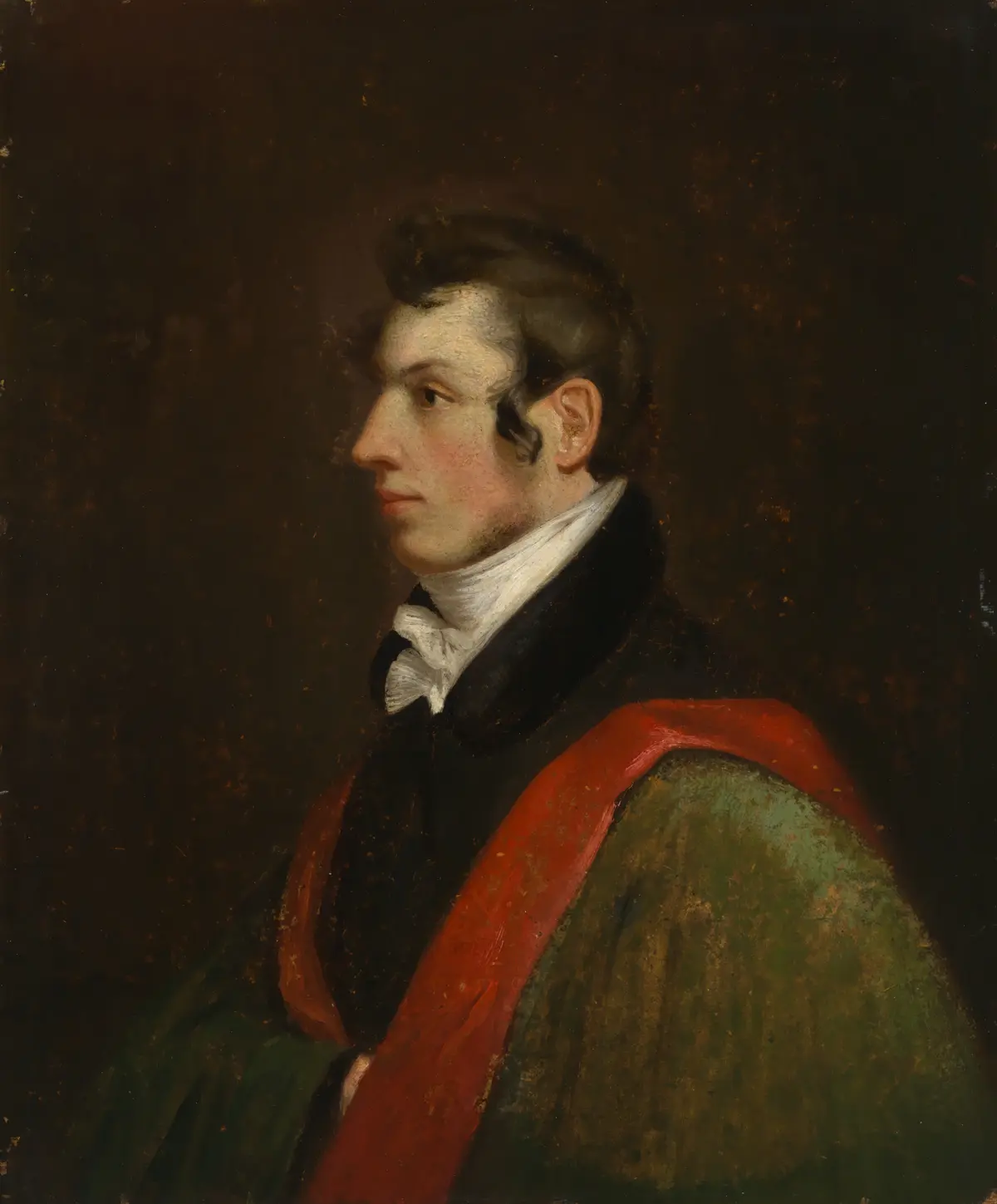
A self-portrait by Samuel F.B. Morse, 1812. Oil on millboard; 10 3/4 inches by 8 7/8 inches. National Portrait Gallery, Smithsonian Institution. (Public Domain)

Born in Charlestown, Massachusetts, Morse was the son of a notable Congregationalist minister. His father, Jedidiah Morse, is known as the “father of American geography,” having written the first book on the subject.

Desiring to become a professional artist, Samuel Morse studied at Yale College and then continued his training at London’s Royal Academy of Arts under Benjamin West, the American-born history painter. During his time at Yale, Morse was exposed to the study of electricity.

After returning from England in 1815, Morse began to work as a portraitist throughout the United States. He received municipal and private commissions to paint prominent citizens. In 1819, the city of Charleston commissioned a portrait of President James Monroe (1758–1831) to commemorate his visit, as it was the first presidential visit since Washington. A second version, circa 1819, by Morse is part of the White House Collection and displayed in the Blue Room.
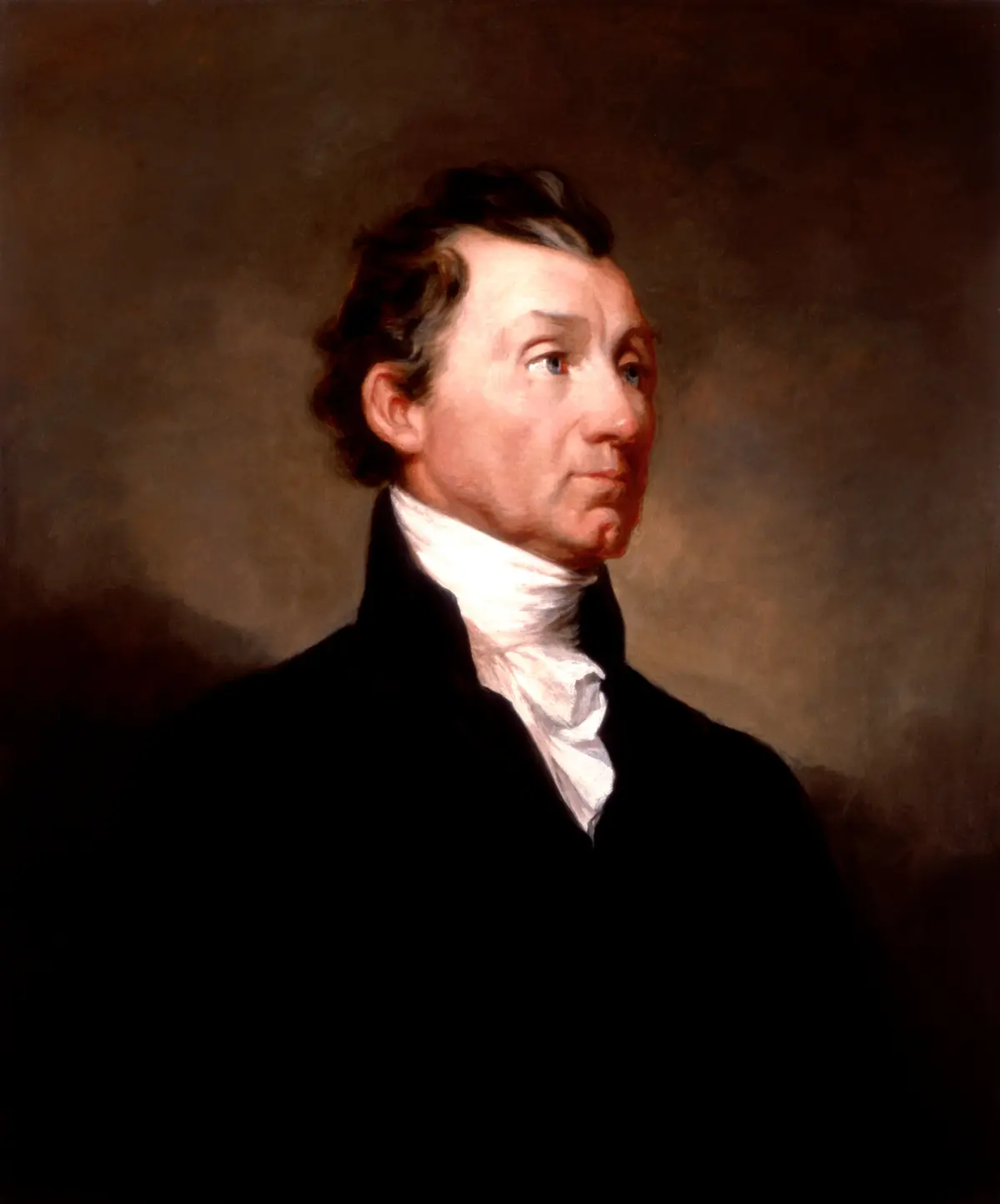
A portrait of James Monroe, circa 1819, by Samuel F. B. Morse. Oil on canvas; 29 3/5 inches by 24 3/5 inches. White House, Washington. (Public Domain)

Exalting Democracy

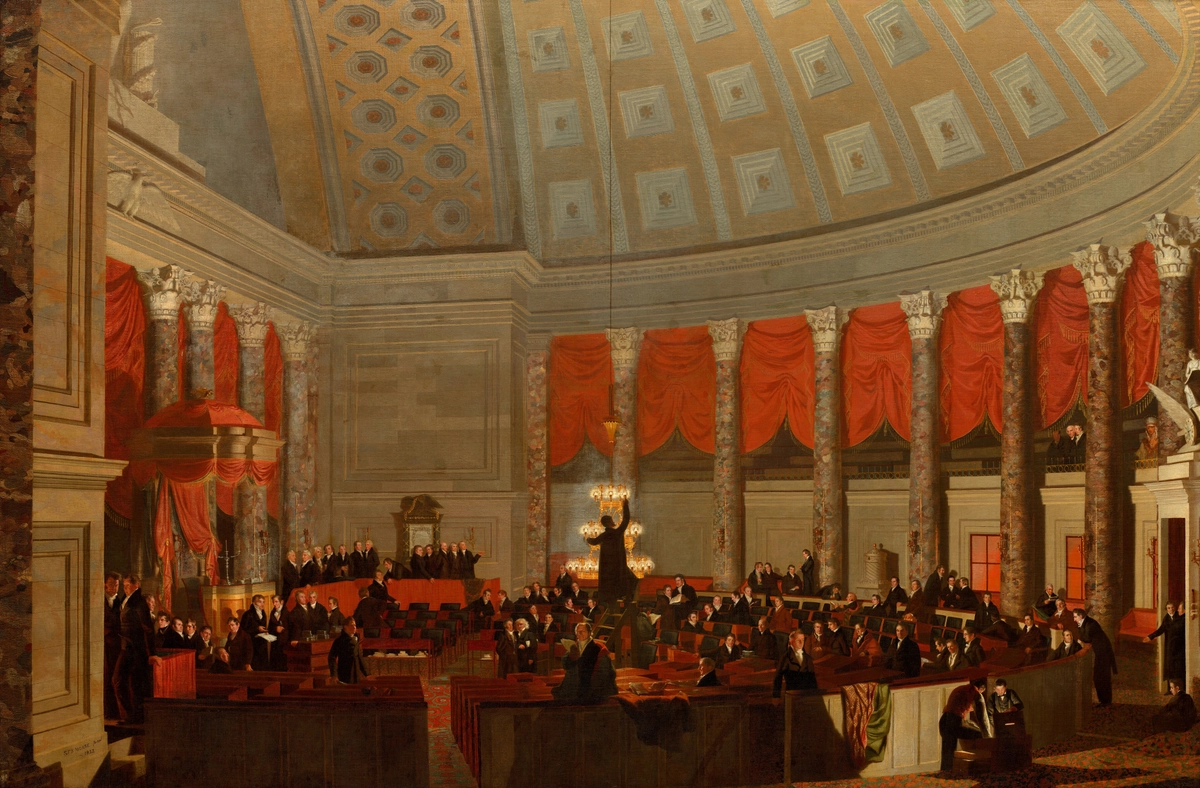
A monumental painting, now part of Washington’s National Gallery of Art, is “The House of Representatives.” Painted from 1821 to 1822 and probably reworked the following year, it was the artist’s first grand painting. In it, Morse exalts American democracy. He depicts the stately House of Representatives chamber with its impressive domed ceiling, columns with carved capitals, dramatic crimson-red curtains, and theater-like boxes.
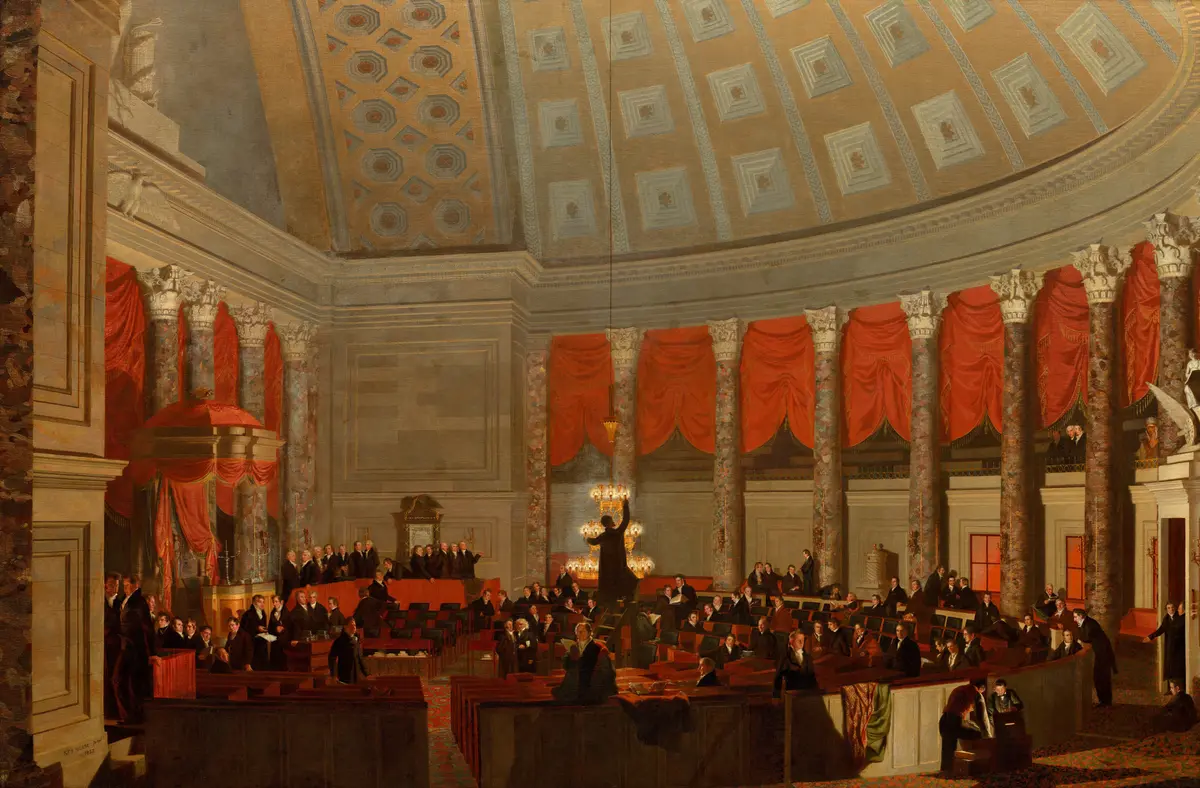
“The House of Representatives,” 1822, probably reworked 1823, by Samuel F. B. Morse. Oil on canvas; 86 7/8 inches by 130 5/8 inches. National Gallery of Art, Washington. (Public Domain)

Morse renders the scene with skillful atmospheric lighting emanating from a three-tiered chandelier. Gathered before an evening session are congressmen, staff, Supreme Court justices, press, and, at the far right in the visitors’ gallery, Chief Petalesharo (Pawnee Nation). Petalesharo had visited President Monroe in 1821. Morse spent four months on site in Washington painting more than 60 individuals for the finished picture. The artist was known for his work ethic—he could do as many as four sittings a day.

Morse had high hopes for this painting, believing it would promote his reputation and boost his finances. He toured it in 1823, but it did not excite the public’s interest. At the time, the American people’s taste did not include history painting, which was held in the highest esteem in Europe. Morse continued painting portraits as a means to support himself and his growing family, though he did not value working in the genre.

Marquis de Lafayette

A new opportunity for increasing his prominence came from the city of New York in 1825. Morse was commissioned to create a likeness of the Revolutionary War veteran Marquis de Lafayette (1757–1834). Lafayette was visiting from France to be honored by federal and state governments for his time volunteering in the Continental Army. The full-length result, finished in 1826, is considered among the finest portraits in American art.

Morse painted this national hero with realistic craggy features and positioned him in a symbolic setting. The departed Founding Fathers and friends of Lafayette, Benjamin Franklin and George Washington, are included as sculpted busts against a sunset-colored sky.
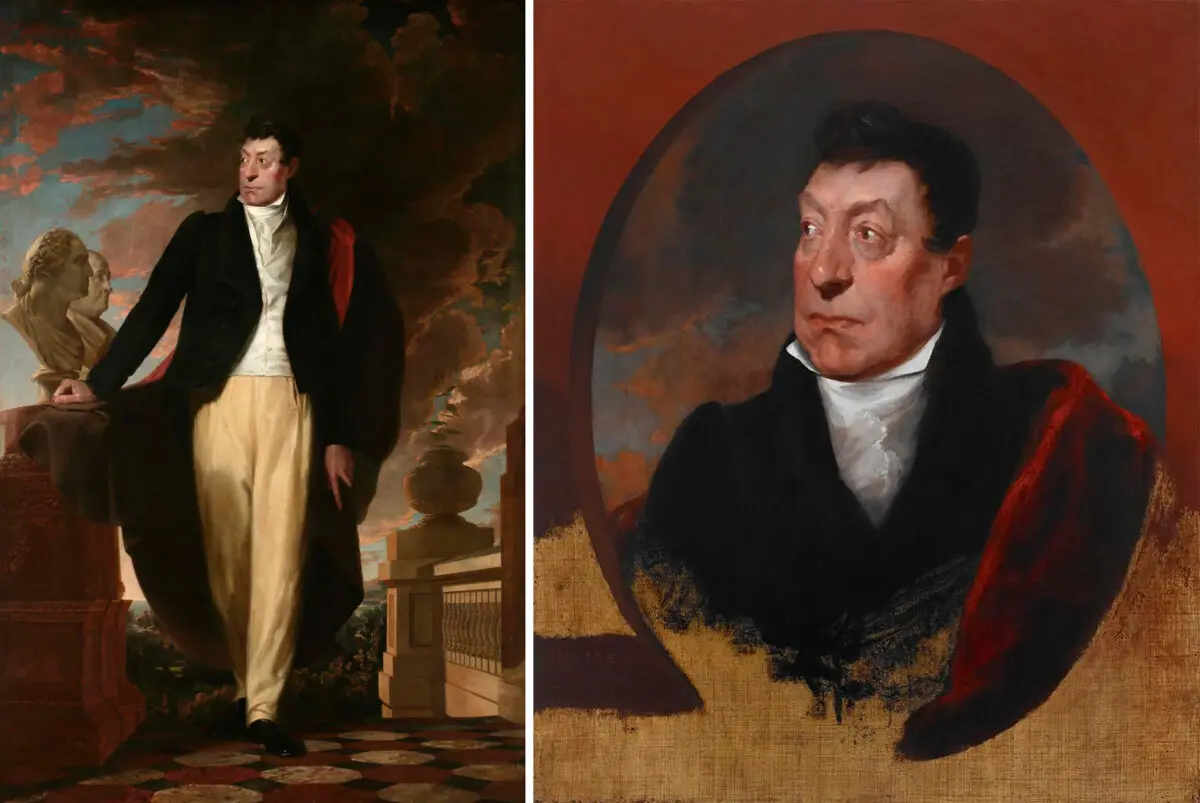
(L) Full-length portrait of Marquis de Lafayette, 1826, by Samuel F. B. Morse. Oil on canvas. City Hall Portrait Collection, New York City. (R) Portrait of Marquis de Lafayette, 1825, by Samuel F. B. Morse. Oil on canvas; 29 7/10 inches by 24 7/10 inches. Crystal Bridges Museum of American Art, Arkansas. (Public Domain)

While working in Washington on a painted study of the Marquis (bought in 2005 by Bentonville, Arkansas’s Crystal Bridges Museum of American Art for $1.36 million), a personal tragedy befell Morse. The museum recounts that Morse received news that his young wife had died unexpectedly while recovering after giving birth to their third child. This was delivered via a messenger on horseback.

By the time Morse arrived home to New Haven, Connecticut, she had already been buried. The widower’s grief was compounded by the lack of speedy long-distance communication. The museum notes, “he began to think about ways to make the relay of important messages faster.”

Fostering Art Appreciation in America

After his wife’s death, Morse lived and taught in New York. He was elected to the American Academy of the Fine Arts, whose mission was to increase the American public’s appreciation of art. Aspiring artists asked for his tutelage, and he formed a Drawing Association whose pupils included Asher B. Durand and Thomas Cole. Joining forces with his students, they formed the National Academy of the Arts of Design in 1826, which was inspired by the Royal Academy, with Morse as president.

Many 19th-century artists went on to study there, including Winslow Homer and George Inness. Morse was later appointed a professor of painting and sculpture at New York University, the first such professorship in the country.

In 1829, Morse went to Paris for a three-year study period. He frequented the Louvre and observed people from different countries and walks of life visiting and experiencing the great works of art. This inspired the quintessential painting of his career, which was also one of his final artworks. “Gallery of the Louvre” is a monumental canvas at 6 feet by 9 feet. He began it in Paris in 1831 and finished the picture in New York in 1833.
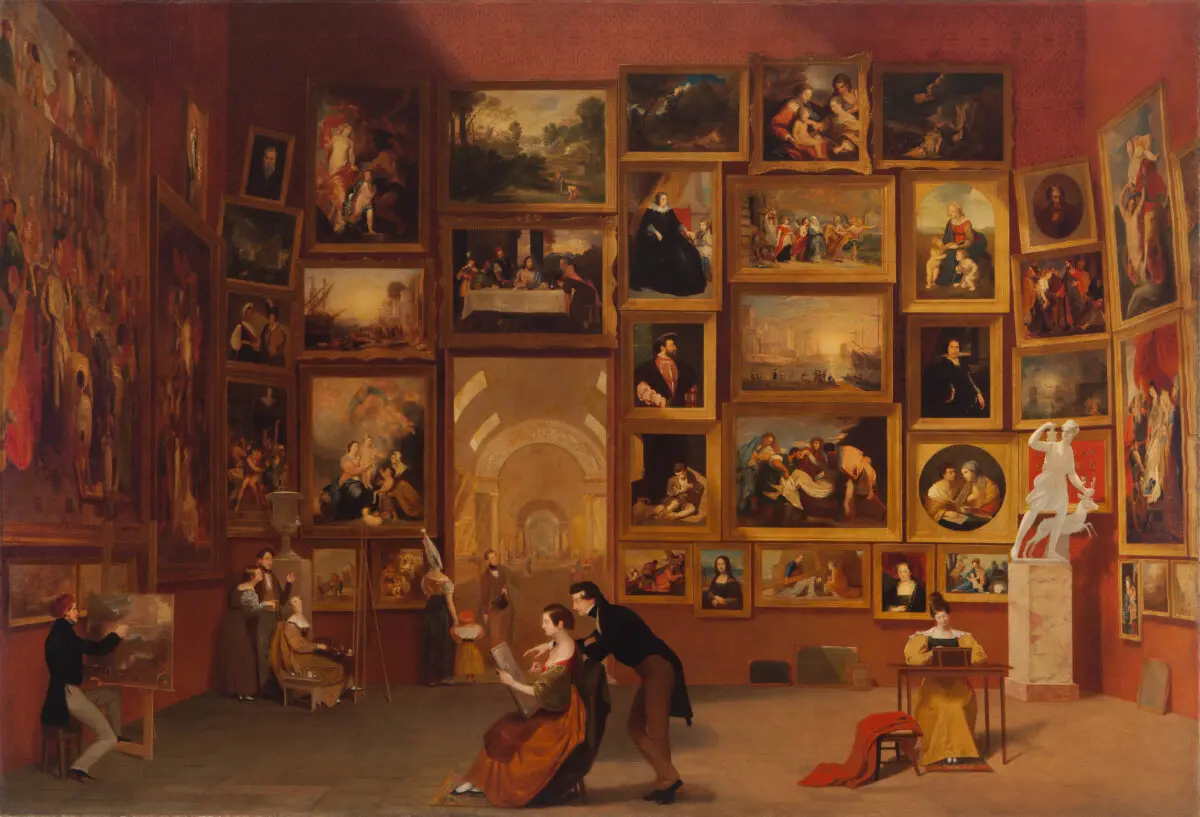
“Gallery of the Louvre,” 1831–1833, by Samuel F. B. Morse. Oil on canvas; 73 3/4 inches by 108 inches. Terra Foundation for American Art, Chicago. (Public Domain)

Fashioned with the aim of educating Americans about European art, Morse sets the painting in the Louvre’s Salon Carré. Employing artistic license, he gathered together 38 paintings and two antiquities on view in different areas of the museum into one gallery, displaying them in a “Salon hang,” a dense stacking from almost floor to ceiling.

Masterpieces by Leonardo da Vinci, including the “Mona Lisa,” Caravaggio, Rembrandt, Rubens, Titian, Anthony van Dyck, and Veronese are meticulously reproduced in miniature, along with the famous Roman marble statue “Diana of Versailles.” This complex composition continues the 17th-century tradition of a “gallery picture.” Morse’s is the only major example of such a scene in all of American art.

“Gallery of the Louvre” is part of the collection of the Chicago-based Terra Foundation for American Art. The foundation wrote that the work “serves as a painted treatise on artistic practice, positioning Morse, depicted as the centrally placed instructor in the work, as a link between European art of the past and America’s cultural future.”

Morse was a close friend of the American author James Fenimore Cooper, famous for “The Last of the Mohicans,” and gave him a cameo in the painting. The writer can be seen in the corner at left with his family.
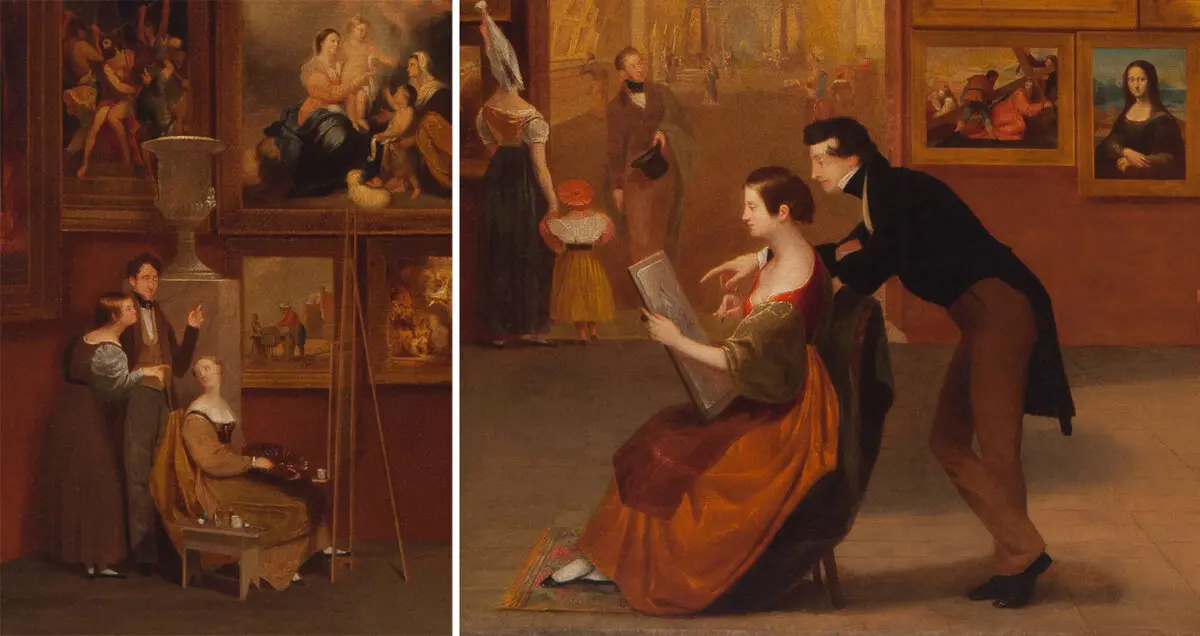
Details of (L) James Fenimore Cooper and his family and (R) Morse instructing student from “Gallery of the Louvre,” 1831–1833, by Samuel F. B. Morse. (Public Domain)

He placed this painting on exhibition twice, in New York City and New Haven. Although it was commended by critics and art aficionados, the public was indifferent. The artist was demoralized. Coupled with losing out on a federal commission to paint a monumental work for the U.S. Capitol Rotunda, Morse put down his brush permanently and pursued electrical experiments instead.

An Invention Sparks

During his transatlantic crossing in 1832 from France to the United States, Morse met Charles Thomas Jackson (1805–1880), who had in-depth discussions with him about electromagnetism and invited him to observe his experiments. This sparked Morse’s idea for developing a means of speedily transmitting long-distance messages over an electrical wire.

Morse developed a device that could send coded messages through a single wire telegraph. In 1843, the House of Representatives passed a bill authorizing him to construct an experimental wire between the Supreme Court Room in Washington and a Baltimore railway depot 40 miles away. On May 24, 1844, he sent the first telegraph message. His device was more efficient in design than other electric telegraphs.
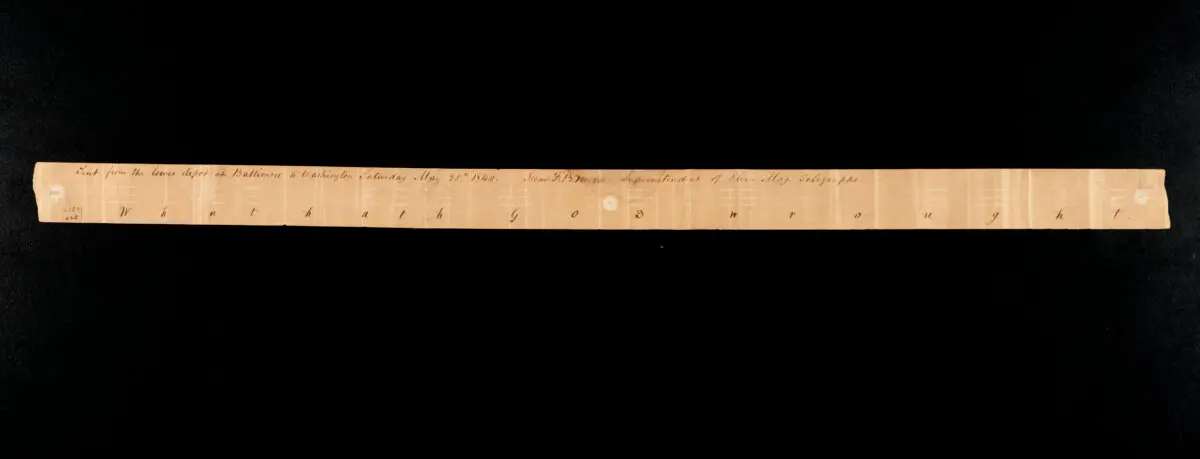
Morse’s telegraph message, “What Hath God Wrought,” sent and transcribed on May 24, 1844. National Museum of American History, Smithsonian, Washington. (Public Domain)

This, along with the development of Morse Code, a system in which letters are represented by combinations of long and short signals, brought him fame and fortune. Morse’s work transformed long-distance communications technology and is considered the forerunner of today’s email.

From May Issue, Volume VI
Categories
Features

Illuminating Culture Through Glass Art

Photographed by Adhiraj Chakrabarti

As an artist and the founder of the Imagine Museum in St. Petersburg, Florida, Trish Duggan has made a name for herself that is synonymous with glass art. Light refracts and colors dance throughout, enveloping visitors in beauty. Home to a captivating collection of glass sculptures, it’s a space born of serendipity, unplanned passion, and unrestricted vision.

“The first piece of glass art I saw was at John Travolta’s house. The light was hitting it, and it looked alive! I was shocked. It was so beautiful,” Duggan said.

She began to collect pieces that caught her eye and touched her heart. One day, an artist whose artwork she collected asked her, “Would you like to see how it’s done?”

“I was mesmerized,” Duggan recalled. “Then she asked, ‘Would you like to do a piece?’ I said, ‘I’d love that.’ Well, that was the ‘Goddess of Compassion.’ That was my first piece that I ever did.”

Infused with deep spirituality, American values, and personal introspection, Duggan’s work as an artist, patron, and philanthropist reflects universal qualities and embodies her journey from humble beginnings to a life of profound influence.

Duggan’s artwork featuring inspirational women pays tribute to the remarkable women who shaped history. 

A Life Shaped by Spirituality and Creativity

Trish Duggan’s story begins in Guam, where she grew up in a military family. “I got my first pair of shoes when I was 5 years old,” she said. During those formative years, she was immersed in the island’s beauty. The beautiful sunsets fired up her love of nature; the ocean’s varied shades of blue and green were imprinted onto her imagination. It also filled her with a sense of abundance. Scarcity was never part of her mindset. Her mother and her father instilled in her a steadfast belief in the American dream. “My mom said, ‘If you study, you can be part of the American dream,’” Duggan recalled.

This ethos of hard work and big dreams propelled her to explore the world and discover a love of art. She still maintains a friendship with her Japanese high school art teacher in California—now 100 years old—who introduced her to Japanese printmaking techniques.

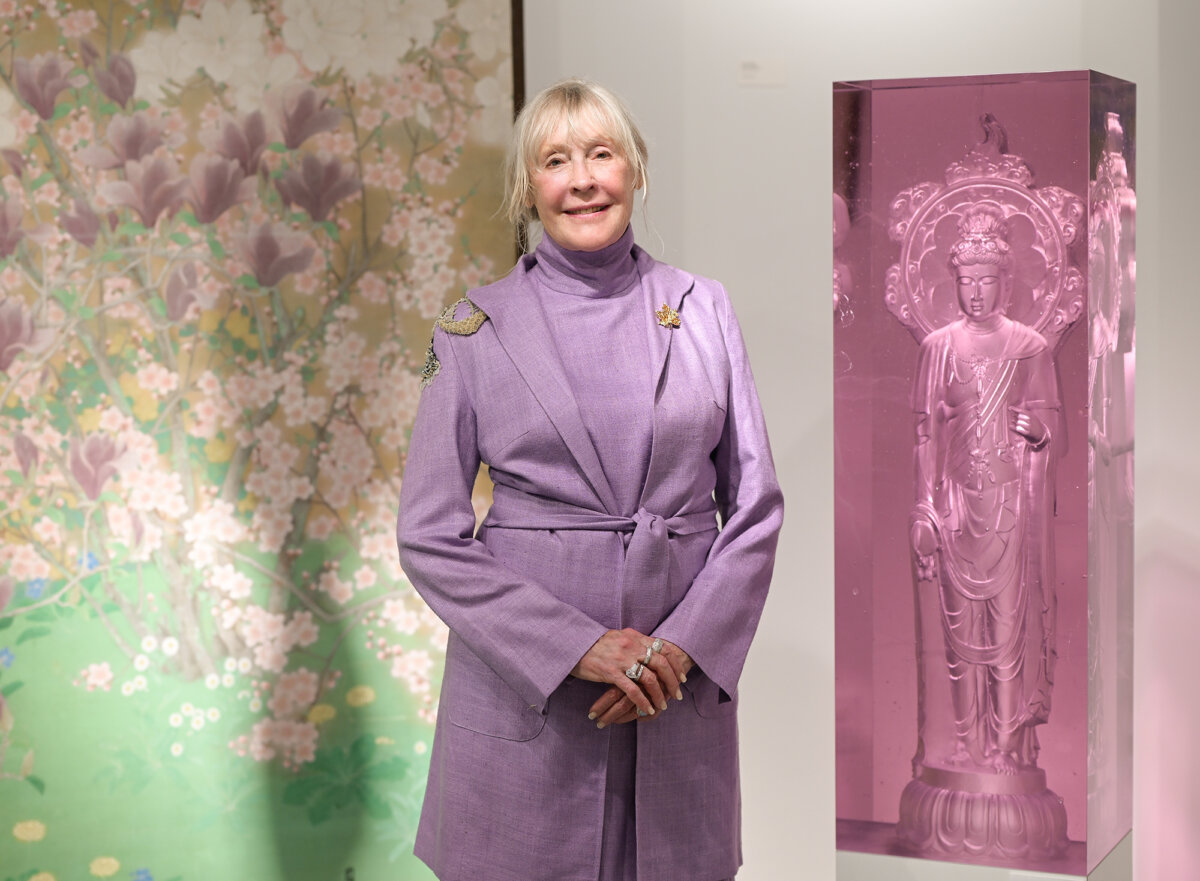
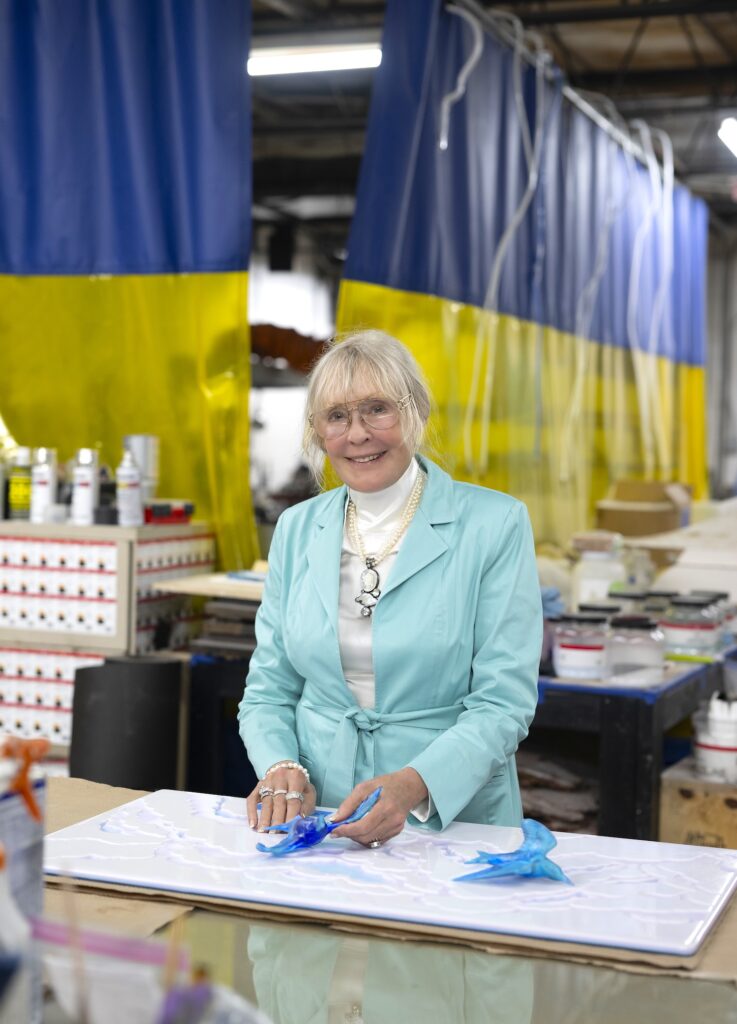
Duggan is a prolific artist. Among her many creations is a 300 pound, pale pink molded-glass sculpture of Quan Yin, the Goddess of Compassion. 

She headed to California to pursue a college degree in political science. Though she was an excellent student, she found herself getting Ds on her papers. When she questioned one of her professors about her low scores, he told her: “It’s your viewpoint [that he disagreed with].” That’s when she realized that she would have to take a different path.

“I’m a dropout,” she said. “It was during the Vietnam War when I went to university; all my teachers were anti-American.” That mindset ran counter to her core beliefs about herself and the world. Seeking an environment free from the political divisiveness in America, she traveled to Nagoya, Japan, to study at Nanzan University. While there, she reconnected with the art and culture she fell in love with in high school, and she began a lifelong appreciation for Buddhism.

After making her first piece of glass art based on a statue of Guan Yin, the Buddhist deity of compassion, she set about creating a series inspired by one of her favorite quotes. “Though you can conquer 1,000 men in battle 1,000 times, the one who conquers himself is the noblest victor of all,” she quoted by heart from a Buddhist text.

Duggan founded the Imagine Museum in St. Petersburg, Fla., in 2018. Its collections showcase the work of American and international glass artists.

The Art of Glass: A Medium of Magic and Inspiration

“Glass is the most important thing that we’ve discovered,” according to Duggan. From microscopes to eyeglasses to fiber optic cables, glass has played a central role in human history.

“How about the mirror alone? The mirror, I say, started the age of introspection: Who am I? What am I doing here? What’s my purpose? We’re all born to help, and where we can help, we should help,” Duggan said.

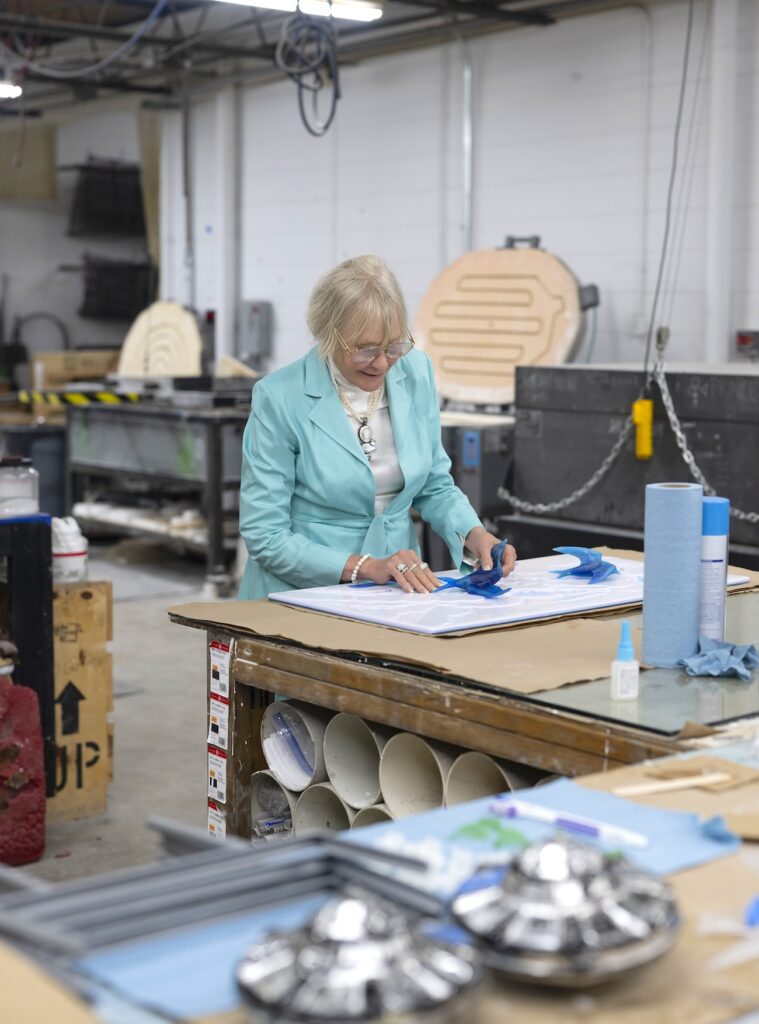
Her artistic process is deeply intuitive. She draws inspiration from everyday life—patterns in a magazine, a stranger’s outfit, or the natural beauty of Guam’s waves and stars. Her St. Petersburg, Florida, studio, TD Glass, is a space where she transforms these inspirations into glass. She became a working artist under glass artist Chuck Boux, who praised her artwork: “You open a portal to serenity that I have never seen before.”

“I’m grateful to be an American and be part of the American dream,” Duggan said. “We’re so fortunate to grow up in freedom, and I’m deeply respectful for every person who has fought for freedom.”

Working with glass is both challenging and exhilarating. In glass casting, glass is melted in a furnace, then poured into a mold. “Not a lot of people want to work with it, because it’s like working with a volcano. It’s 2,100 degrees. It’s all melted sand. It’s very hot to work with, and you don’t know how it’s going to turn out,” she said.

In her artwork, Duggan uses a variety of techniques that allow her to incorporate intricate detail and expressive forms. Her distinctive style blends traditional techniques with innovative approaches. Drawing from her background in Japanese woodblock printmaking, she presses woodblocks into sand to create a mold. Then she pours molten glass into the mold to capture the design.

portrait
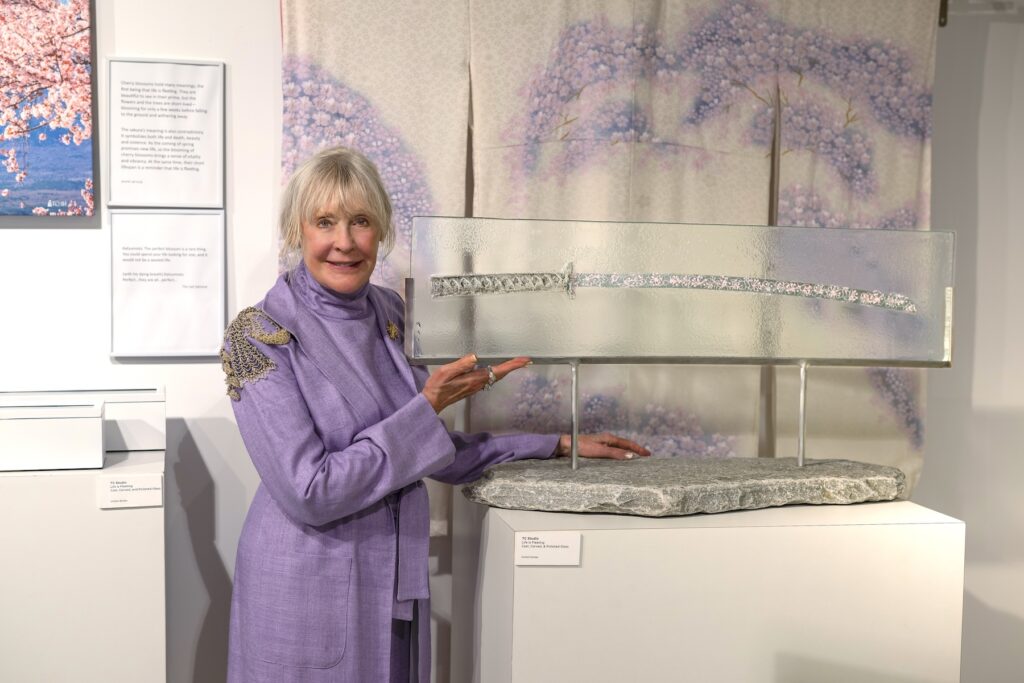
Duggan points to “Life Is Fleeting,” fashioned out of fused, etched, and polished glass, and created by TC Studio. (Adhiraj Chakrabarti)

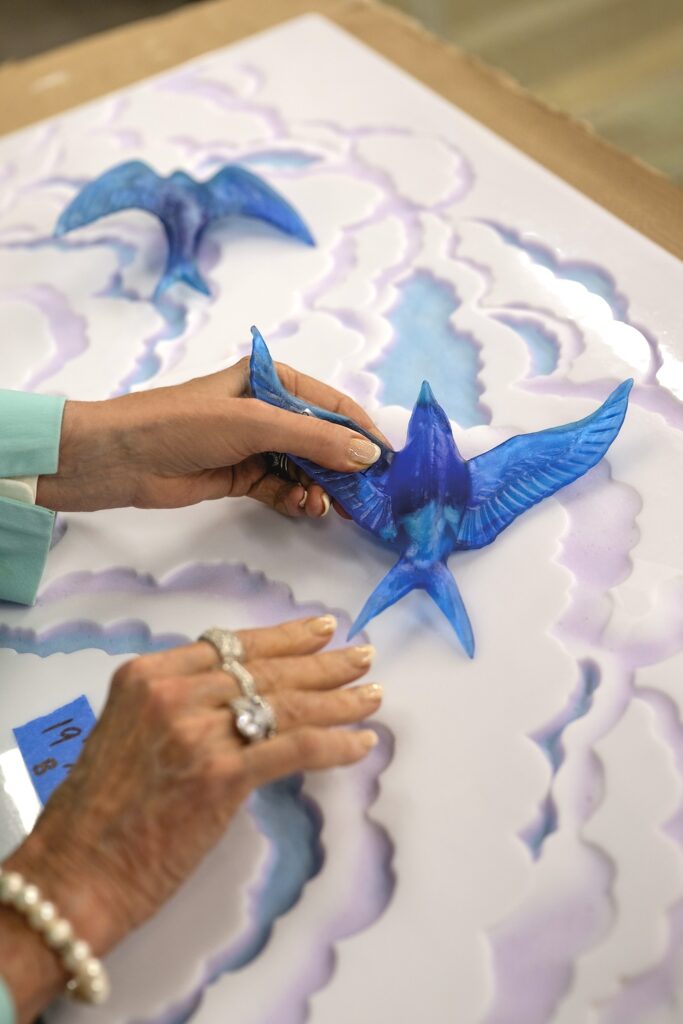
To create the delicate flowers adorning some of her pieces, she uses pâte de verre, made by pressing molten frit (finely ground glass) into molds. Her tropical-themed pieces often feature shells and seahorses and reflect her love for nature and imagination. They incorporate impressions of leaves, shells, and other items from nature that she collects herself.

The medium’s ability to interact with light and create a sense of vitality captivates her. “The most magical thing about glass is what happens when light hits it,” she said.

A Spiritual and Social Vision

When she’s immersed in her work, time slips away. “When I’m in that moment of creation, it’s very spiritual. I’m absolutely in the moment,” Duggan said. “I have raised eight kids, and sometimes I was so into working on a project that when I looked up at the clock, it was 4 o’clock in the morning, and I’ve still got to get up and get my kids to school.”

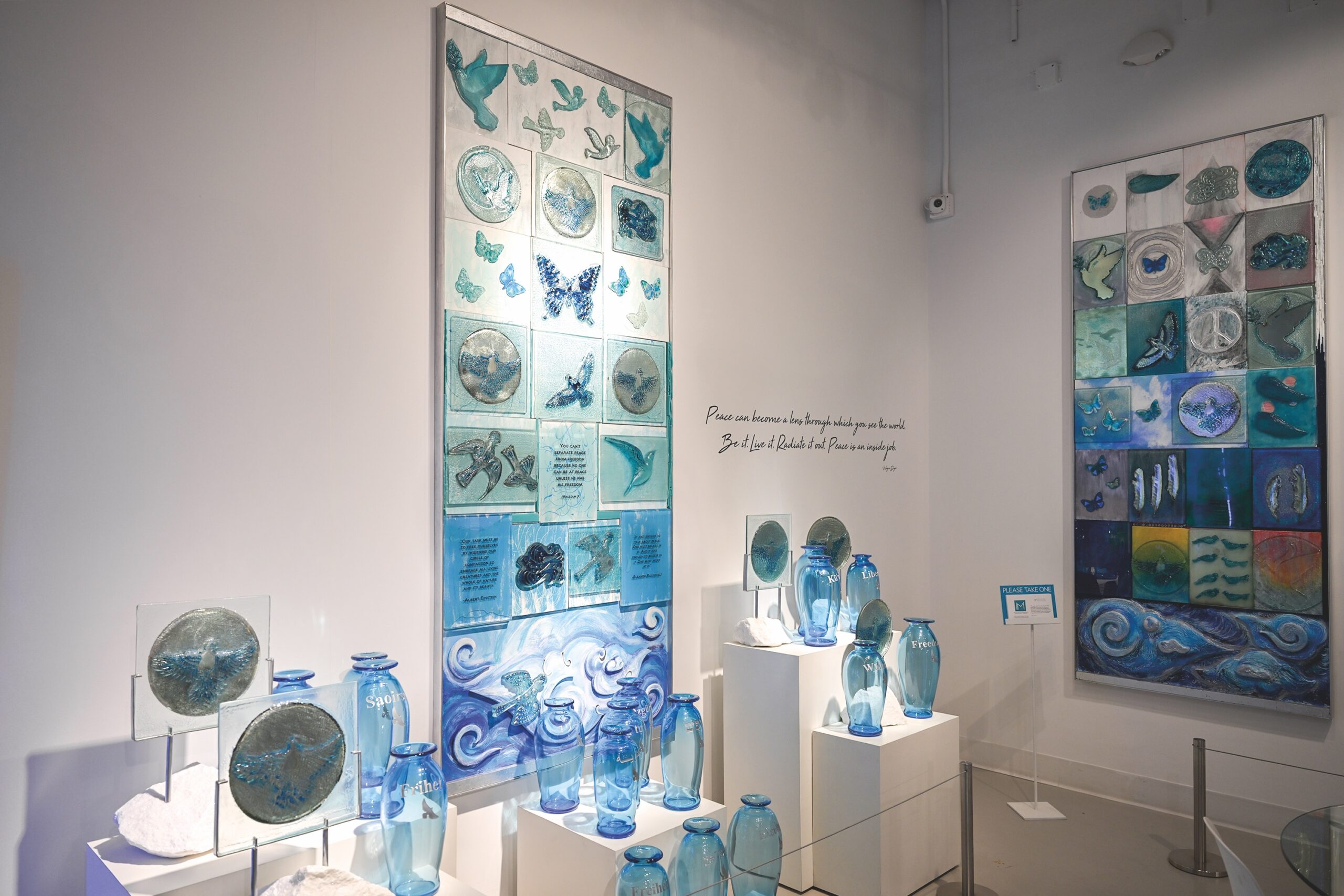
Duggan has a great affinity for the color blue, which evokes peace, imagination, and creativity. She is the author of the book “The Beauty of Blue.”

That drive manifests not only in Duggan’s art, but also in her business and philanthropic endeavors. In 2018, she opened the Imagine Museum in Florida, and she is a board member of the projected Museum for Peace in Costa Rica. She also has plans to open an international museum of glass art, and she is a newly appointed board member of the John F. Kennedy Center for the Performing Arts in Washington.

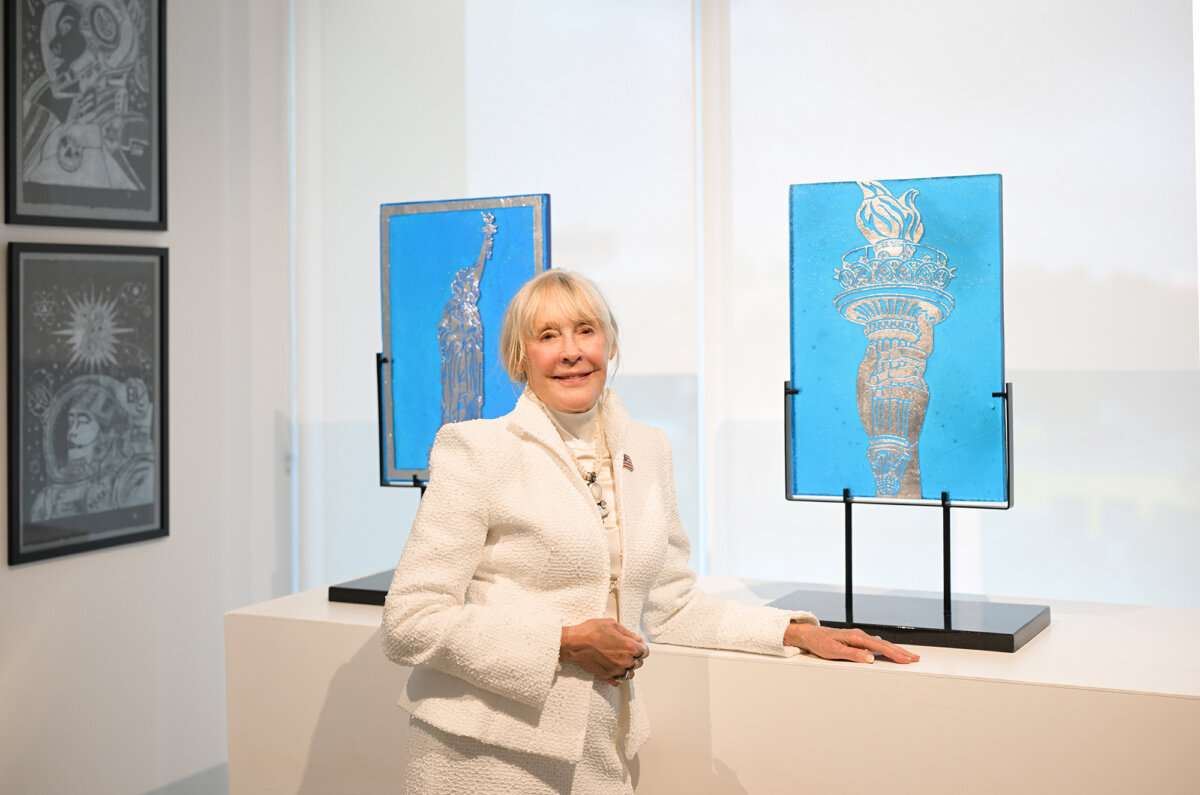
In all her work, Duggan said she hopes to promote American values and support universal human rights. Her Americana room at the Imagine Museum features symbols like the Statue of Liberty and astronauts. It celebrates the spirit of freedom and exploration.

Her experiences in communist countries deepened her appreciation for American freedoms. She recounted a chilling incident in China after she left a picture of the Dalai Lama at a monastery, saying, “I wanted them to know it was the Dalai Lama’s monastery.” Though she and her group were under military surveillance for the rest of the trip, Duggan felt no fear. It only reinforced her dedication to human rights advocacy.

She also highlighted a documentary she once saw about the persecution of Falun Gong in China. Since 1999, the Chinese Communist Party has imprisoned and tortured adherents of the Buddhism-inspired practice, which is based on truthfulness, compassion, and tolerance.

artwork
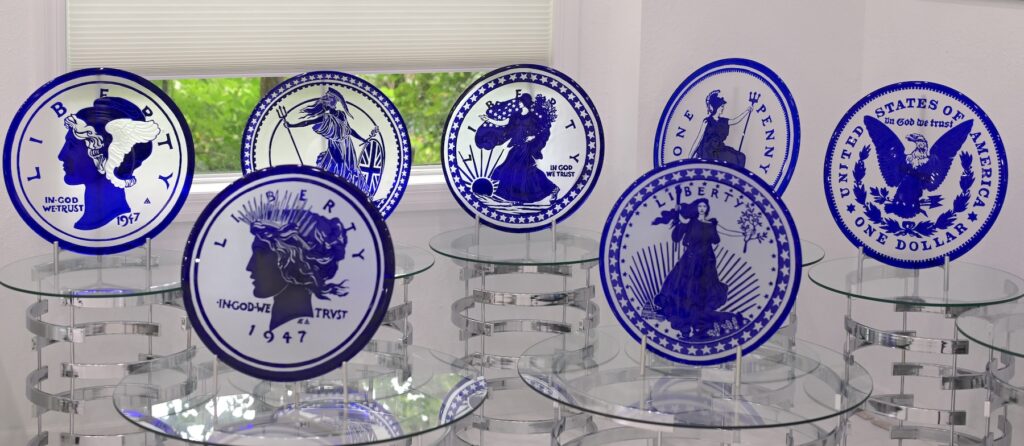
The techniques employed by Duggan enable her to render delicate details.

“It was so shocking to me. I said, ‘I’m going to do something about it.’ There was nobody who wanted to do anything about it,” she said about the CCP’s lucrative organ harvesting crimes. “You can go and get a liver for very cheap [in China], you could go into the prison and say, ‘Oh, that 18-year-old girl from Falun Gong, I’ll take her lungs,’ and then they don’t use any anesthesia. It’s just criminal what’s going on on the planet.”

“We’re all born free and equal in dignity and rights,” she asserted, emphasizing the need to honor individual worth. “We have to leave a future of freedom, not one of slavery.”

Duggan’s compassion doesn’t just manifest in her art and philanthropy. She grounds her daily life in the same values. She has adopted six children from foster care. After her own success in business, she supported her mother’s education, which was put on hold when she became pregnant at age 16 and eventually culminated in two master’s degrees and a doctorate.

Cultural Leadership and Future Aspirations

Duggan sees art as a unifying force in a divided world, with the power to transcend political and social divides. “People who are on the opposite end of the spectrum than I am … come [into the museum] and they’re like, ‘This is so beautiful.Thank you so much. It’s so uplifting,’” she noted. Her next project aims to “celebrate the future generation,” emphasizing freedom and creativity and countering oppression.

As a patron of the arts and steward of cultural institutions, she hopes her philosophy of compassion and freedom will light a path toward a more inspired and united society.

studio
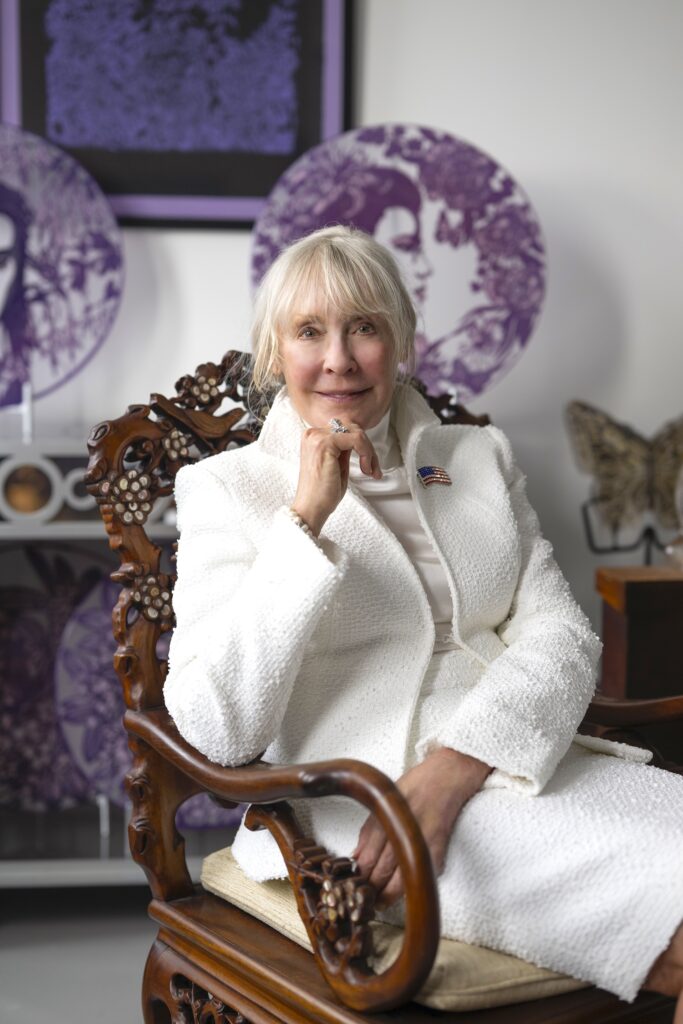
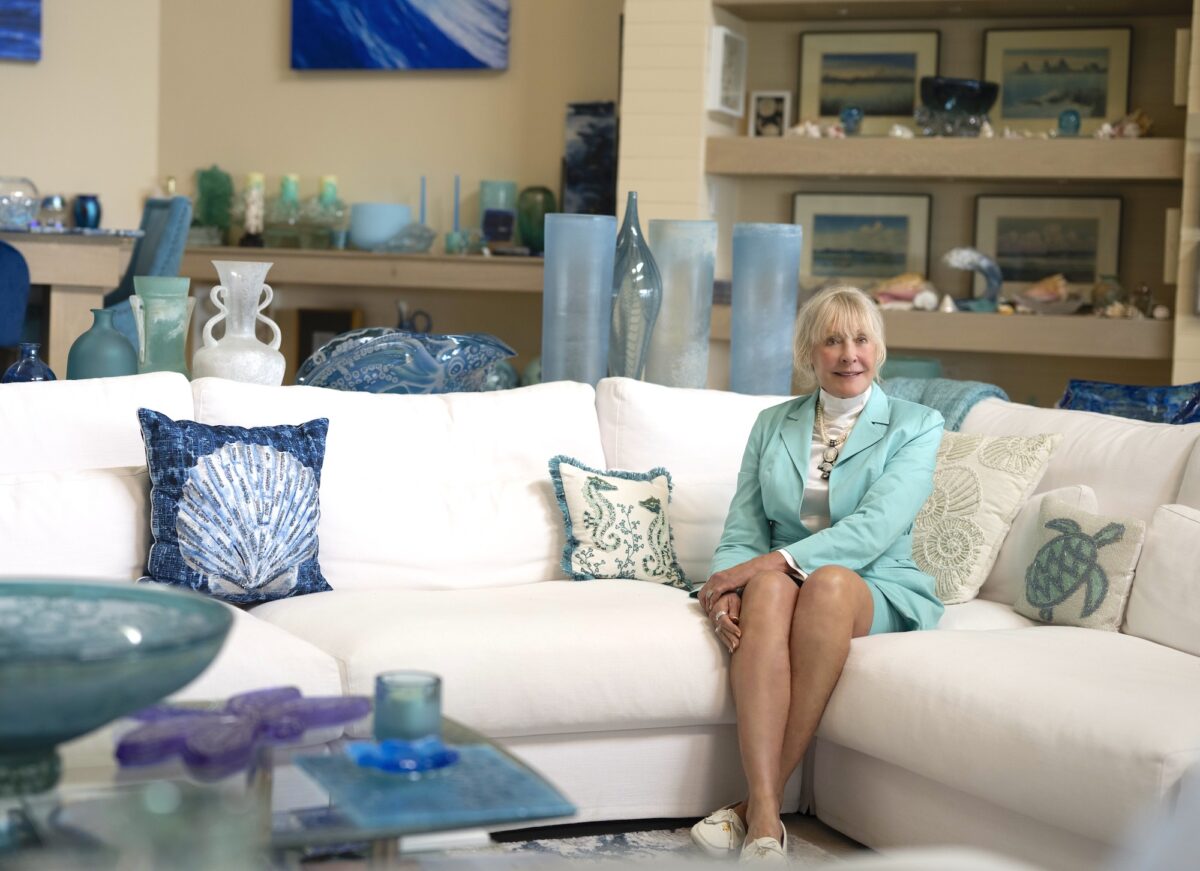
Trish Duggan at TD Glass, her design and fabrication studio in St. Petersburg’s Arts District.

“If you look for beauty, you find beauty. There’s tons of ugliness out there. There’s tons of divisiveness. There’s lots of hatred. If you look for that, you’re going to find it. But I don’t happen to try to look for that. I look for the beauty in things,” she said.

Duggan’s plans and ideas keep her plenty busy. “I’ve got at least three file boxes full of all different projects. I need to live to 250 to get all of these done. Somehow, I’ve got to cheat death or something,” she laughed.

She fervently believes in the transformative power of art: “That’s the artist’s job—to lead people into the future, to create beauty. The purpose of the artist is to help bring man up into the future. That’s culture.”

From Sept. Issue, Volume V