Categories
History

Did You Know the Morse Code Inventor Was an Artist?

Samuel F.B. Morse (1791–1872) is famous throughout the world for co-inventing the electromagnetic telegraph and developing his namesake Morse code. The great societal impact of his scientific career is coupled with a lesser known but influential artistic legacy. In his lifetime, Morse was a critically acclaimed artist, especially in the genre of portraiture.

Trained in England and France, he was passionate about fostering art appreciation in the United States. After he struggled to receive commissions for his grand ambition of history painting, Morse abandoned his art career for inventing; history was then made. However, his important canvases continue to be admired, and his educational efforts nurtured subsequent generations of American artists.

An Aspiring Artist
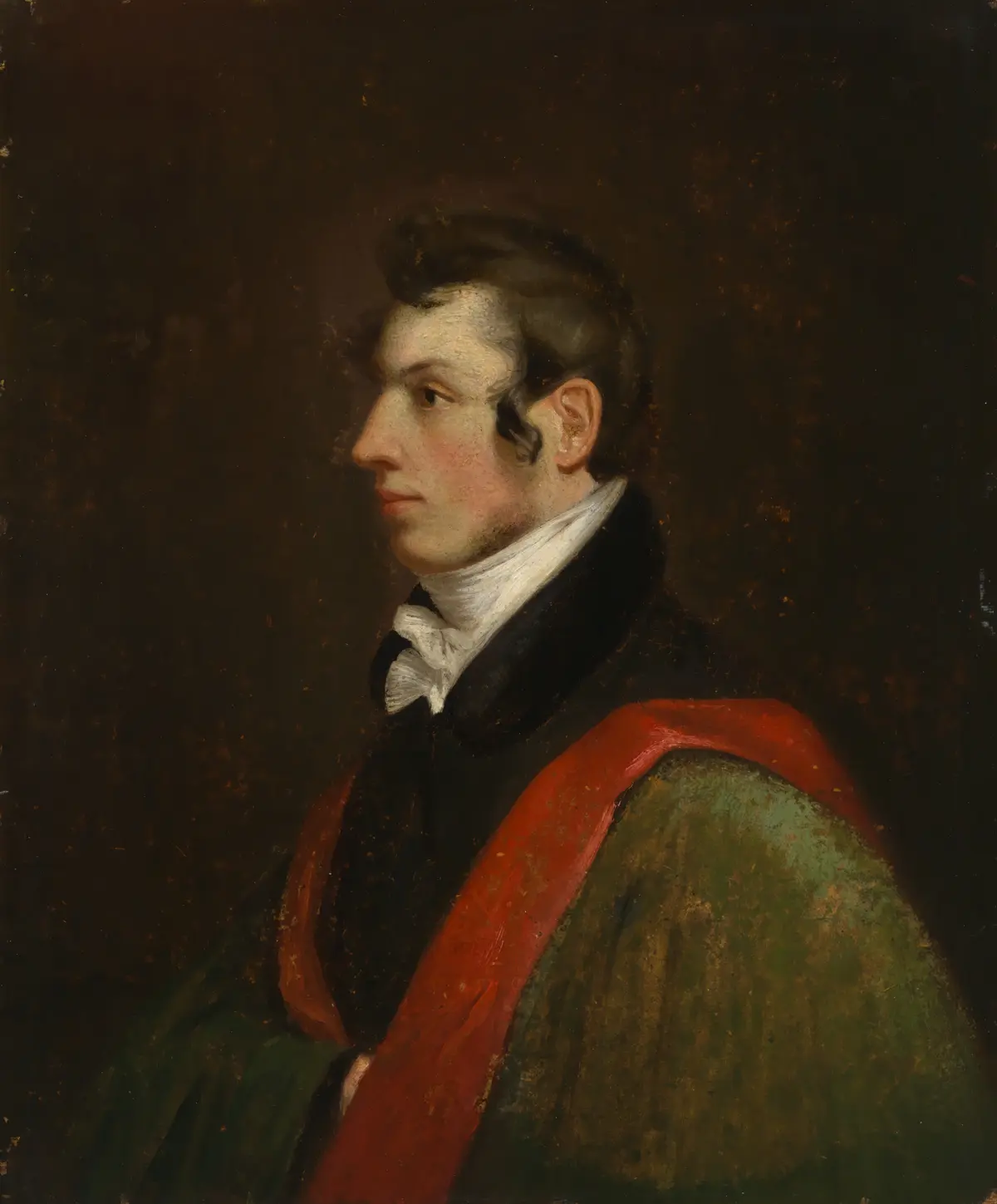
A self-portrait by Samuel F.B. Morse, 1812. Oil on millboard; 10 3/4 inches by 8 7/8 inches. National Portrait Gallery, Smithsonian Institution. (Public Domain)

Born in Charlestown, Massachusetts, Morse was the son of a notable Congregationalist minister. His father, Jedidiah Morse, is known as the “father of American geography,” having written the first book on the subject.

Desiring to become a professional artist, Samuel Morse studied at Yale College and then continued his training at London’s Royal Academy of Arts under Benjamin West, the American-born history painter. During his time at Yale, Morse was exposed to the study of electricity.

After returning from England in 1815, Morse began to work as a portraitist throughout the United States. He received municipal and private commissions to paint prominent citizens. In 1819, the city of Charleston commissioned a portrait of President James Monroe (1758–1831) to commemorate his visit, as it was the first presidential visit since Washington. A second version, circa 1819, by Morse is part of the White House Collection and displayed in the Blue Room.
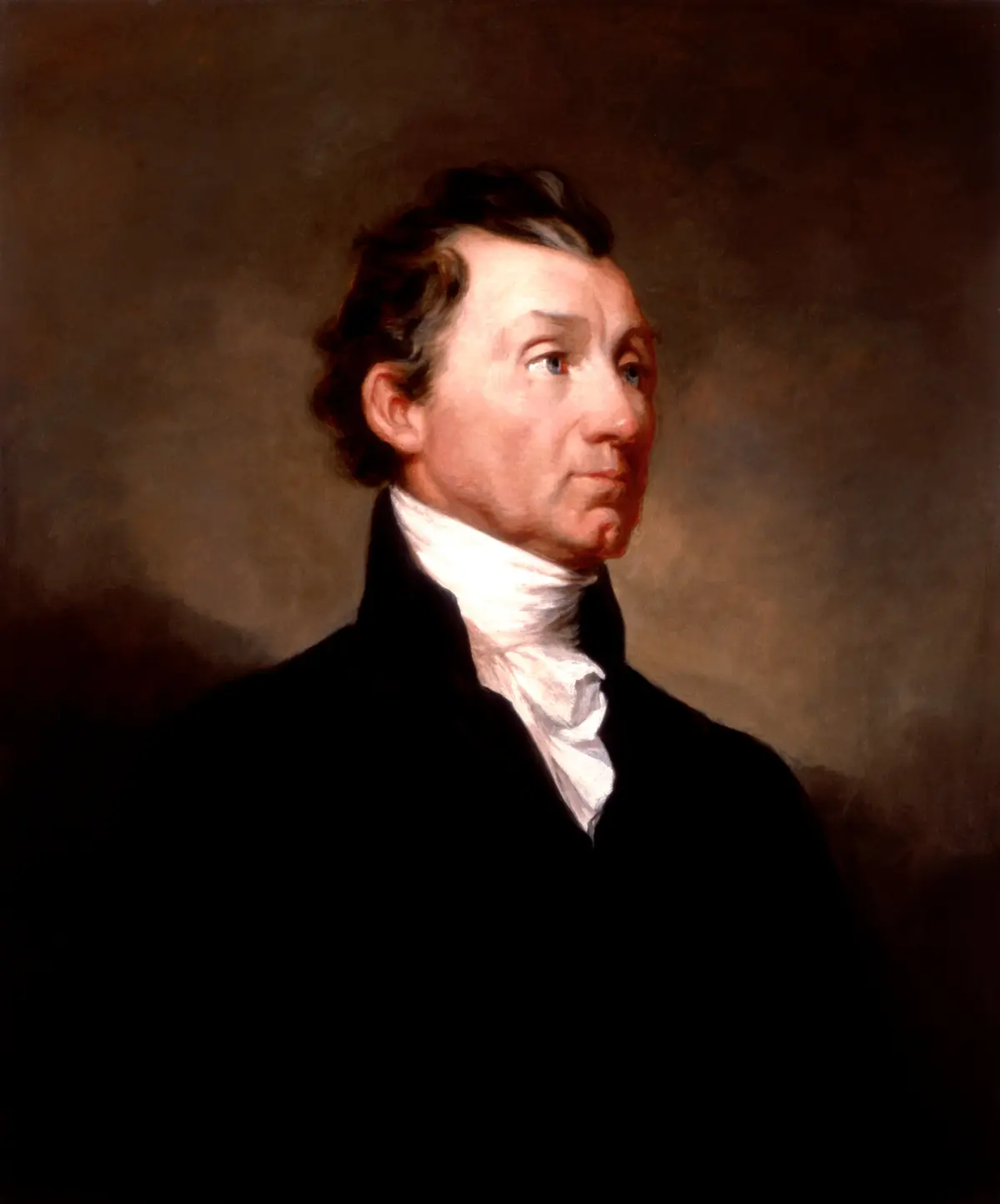
A portrait of James Monroe, circa 1819, by Samuel F. B. Morse. Oil on canvas; 29 3/5 inches by 24 3/5 inches. White House, Washington. (Public Domain)

Exalting Democracy

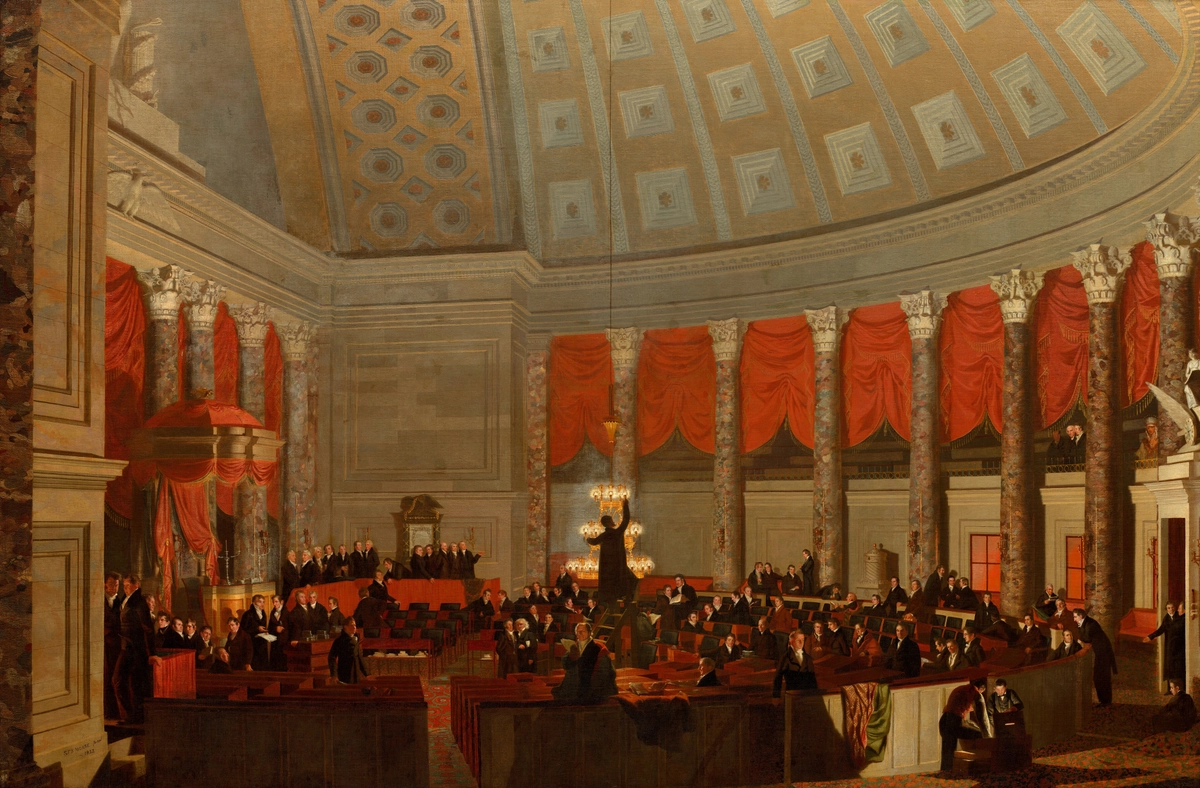
A monumental painting, now part of Washington’s National Gallery of Art, is “The House of Representatives.” Painted from 1821 to 1822 and probably reworked the following year, it was the artist’s first grand painting. In it, Morse exalts American democracy. He depicts the stately House of Representatives chamber with its impressive domed ceiling, columns with carved capitals, dramatic crimson-red curtains, and theater-like boxes.
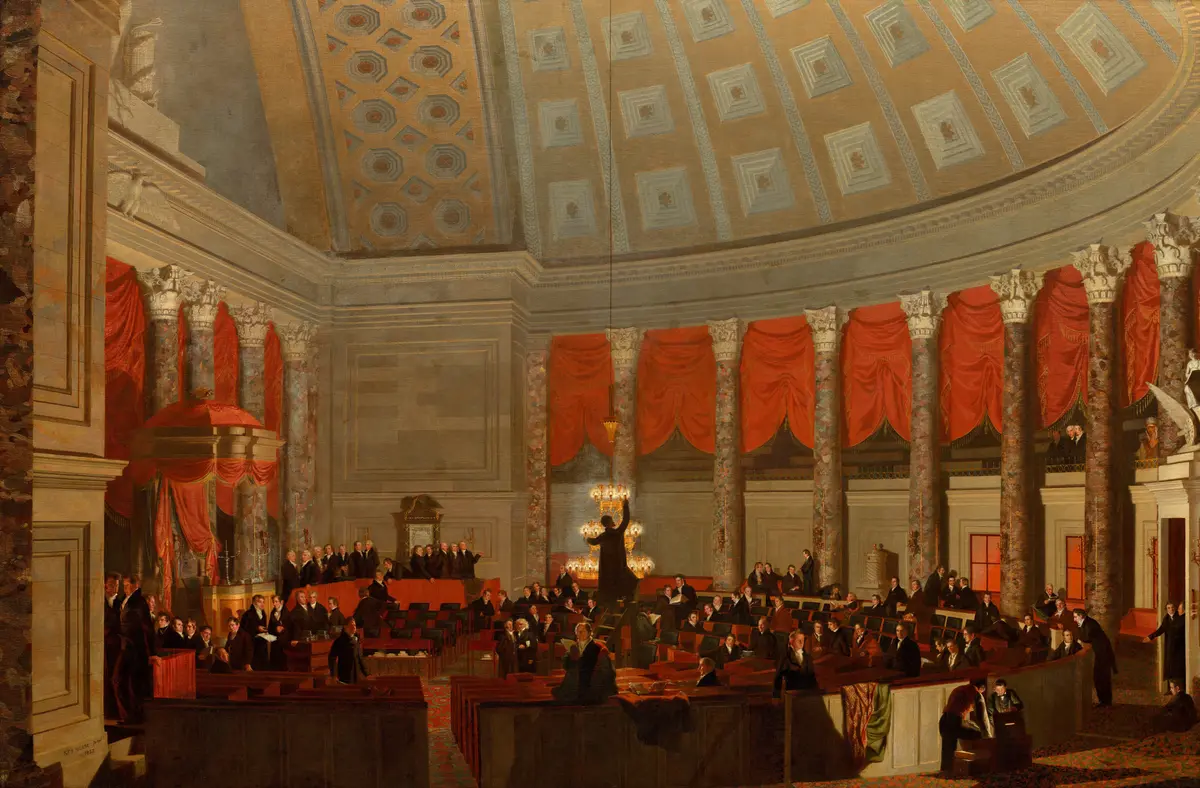
“The House of Representatives,” 1822, probably reworked 1823, by Samuel F. B. Morse. Oil on canvas; 86 7/8 inches by 130 5/8 inches. National Gallery of Art, Washington. (Public Domain)

Morse renders the scene with skillful atmospheric lighting emanating from a three-tiered chandelier. Gathered before an evening session are congressmen, staff, Supreme Court justices, press, and, at the far right in the visitors’ gallery, Chief Petalesharo (Pawnee Nation). Petalesharo had visited President Monroe in 1821. Morse spent four months on site in Washington painting more than 60 individuals for the finished picture. The artist was known for his work ethic—he could do as many as four sittings a day.

Morse had high hopes for this painting, believing it would promote his reputation and boost his finances. He toured it in 1823, but it did not excite the public’s interest. At the time, the American people’s taste did not include history painting, which was held in the highest esteem in Europe. Morse continued painting portraits as a means to support himself and his growing family, though he did not value working in the genre.

Marquis de Lafayette

A new opportunity for increasing his prominence came from the city of New York in 1825. Morse was commissioned to create a likeness of the Revolutionary War veteran Marquis de Lafayette (1757–1834). Lafayette was visiting from France to be honored by federal and state governments for his time volunteering in the Continental Army. The full-length result, finished in 1826, is considered among the finest portraits in American art.

Morse painted this national hero with realistic craggy features and positioned him in a symbolic setting. The departed Founding Fathers and friends of Lafayette, Benjamin Franklin and George Washington, are included as sculpted busts against a sunset-colored sky.
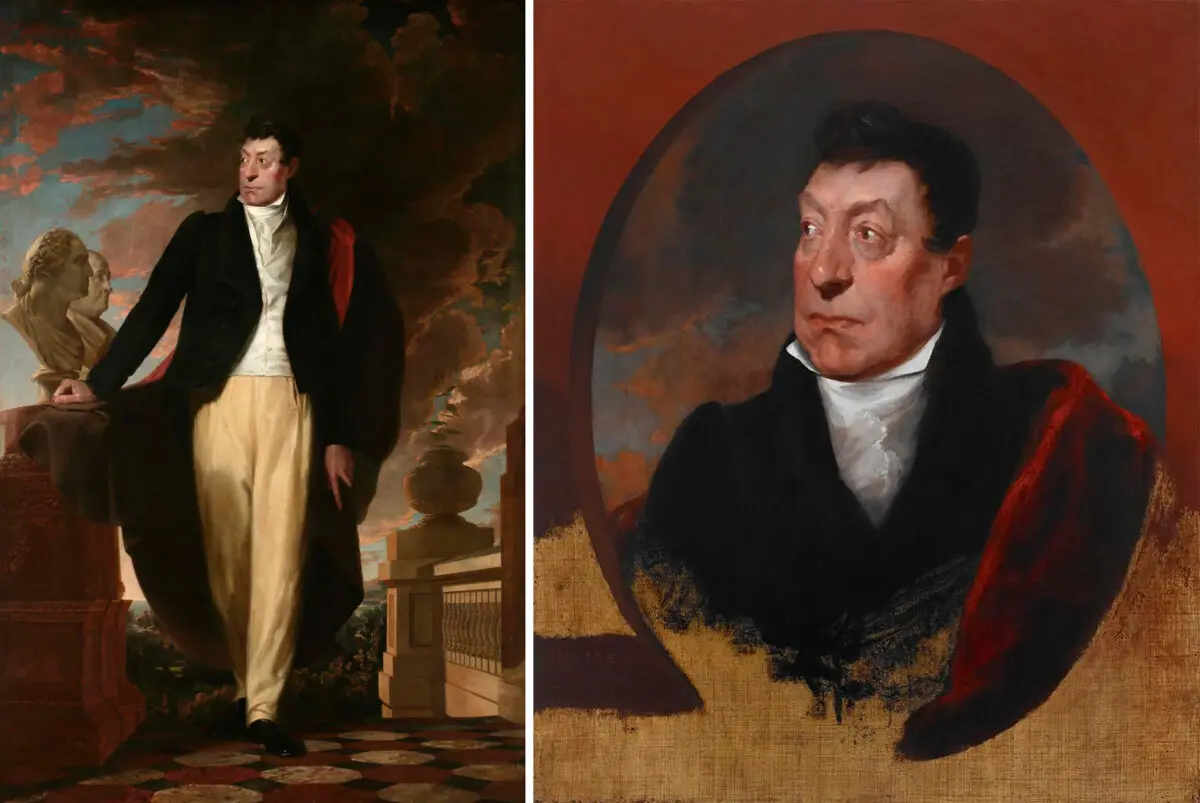
(L) Full-length portrait of Marquis de Lafayette, 1826, by Samuel F. B. Morse. Oil on canvas. City Hall Portrait Collection, New York City. (R) Portrait of Marquis de Lafayette, 1825, by Samuel F. B. Morse. Oil on canvas; 29 7/10 inches by 24 7/10 inches. Crystal Bridges Museum of American Art, Arkansas. (Public Domain)

While working in Washington on a painted study of the Marquis (bought in 2005 by Bentonville, Arkansas’s Crystal Bridges Museum of American Art for $1.36 million), a personal tragedy befell Morse. The museum recounts that Morse received news that his young wife had died unexpectedly while recovering after giving birth to their third child. This was delivered via a messenger on horseback.

By the time Morse arrived home to New Haven, Connecticut, she had already been buried. The widower’s grief was compounded by the lack of speedy long-distance communication. The museum notes, “he began to think about ways to make the relay of important messages faster.”

Fostering Art Appreciation in America

After his wife’s death, Morse lived and taught in New York. He was elected to the American Academy of the Fine Arts, whose mission was to increase the American public’s appreciation of art. Aspiring artists asked for his tutelage, and he formed a Drawing Association whose pupils included Asher B. Durand and Thomas Cole. Joining forces with his students, they formed the National Academy of the Arts of Design in 1826, which was inspired by the Royal Academy, with Morse as president.

Many 19th-century artists went on to study there, including Winslow Homer and George Inness. Morse was later appointed a professor of painting and sculpture at New York University, the first such professorship in the country.

In 1829, Morse went to Paris for a three-year study period. He frequented the Louvre and observed people from different countries and walks of life visiting and experiencing the great works of art. This inspired the quintessential painting of his career, which was also one of his final artworks. “Gallery of the Louvre” is a monumental canvas at 6 feet by 9 feet. He began it in Paris in 1831 and finished the picture in New York in 1833.
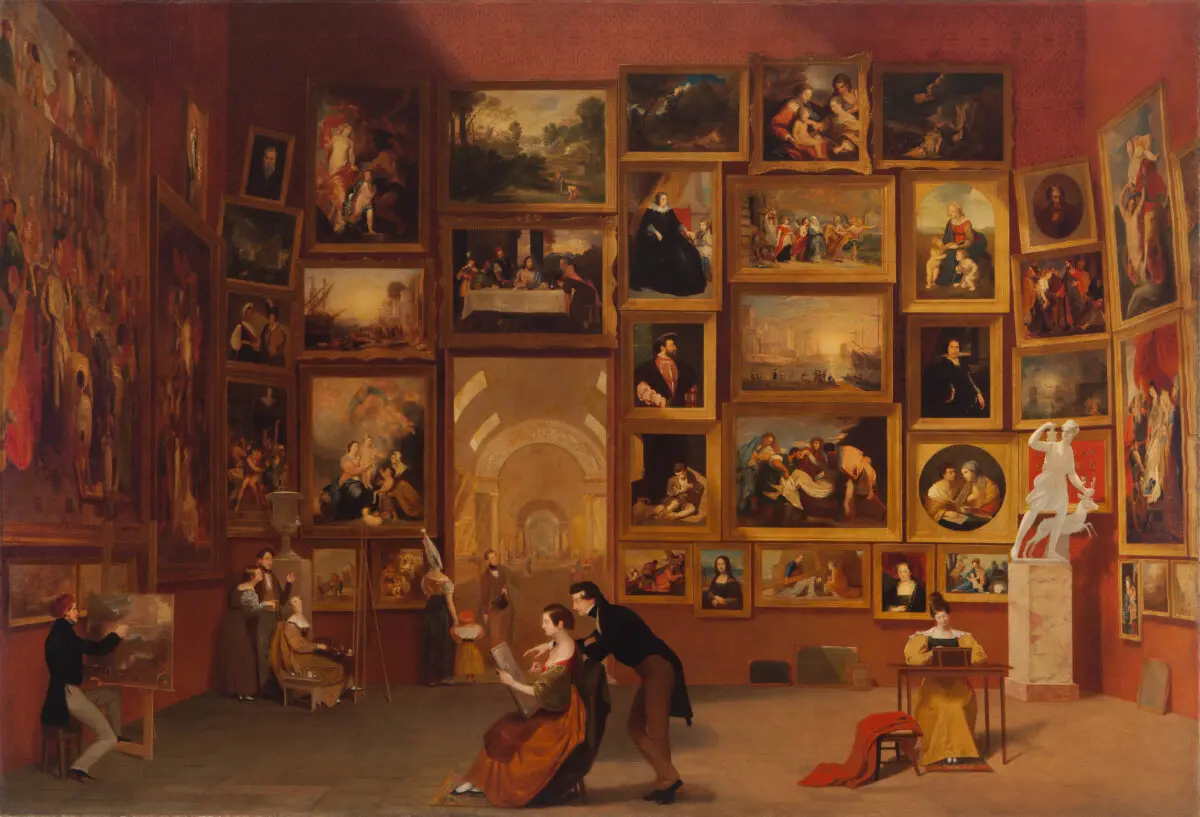
“Gallery of the Louvre,” 1831–1833, by Samuel F. B. Morse. Oil on canvas; 73 3/4 inches by 108 inches. Terra Foundation for American Art, Chicago. (Public Domain)

Fashioned with the aim of educating Americans about European art, Morse sets the painting in the Louvre’s Salon Carré. Employing artistic license, he gathered together 38 paintings and two antiquities on view in different areas of the museum into one gallery, displaying them in a “Salon hang,” a dense stacking from almost floor to ceiling.

Masterpieces by Leonardo da Vinci, including the “Mona Lisa,” Caravaggio, Rembrandt, Rubens, Titian, Anthony van Dyck, and Veronese are meticulously reproduced in miniature, along with the famous Roman marble statue “Diana of Versailles.” This complex composition continues the 17th-century tradition of a “gallery picture.” Morse’s is the only major example of such a scene in all of American art.

“Gallery of the Louvre” is part of the collection of the Chicago-based Terra Foundation for American Art. The foundation wrote that the work “serves as a painted treatise on artistic practice, positioning Morse, depicted as the centrally placed instructor in the work, as a link between European art of the past and America’s cultural future.”

Morse was a close friend of the American author James Fenimore Cooper, famous for “The Last of the Mohicans,” and gave him a cameo in the painting. The writer can be seen in the corner at left with his family.
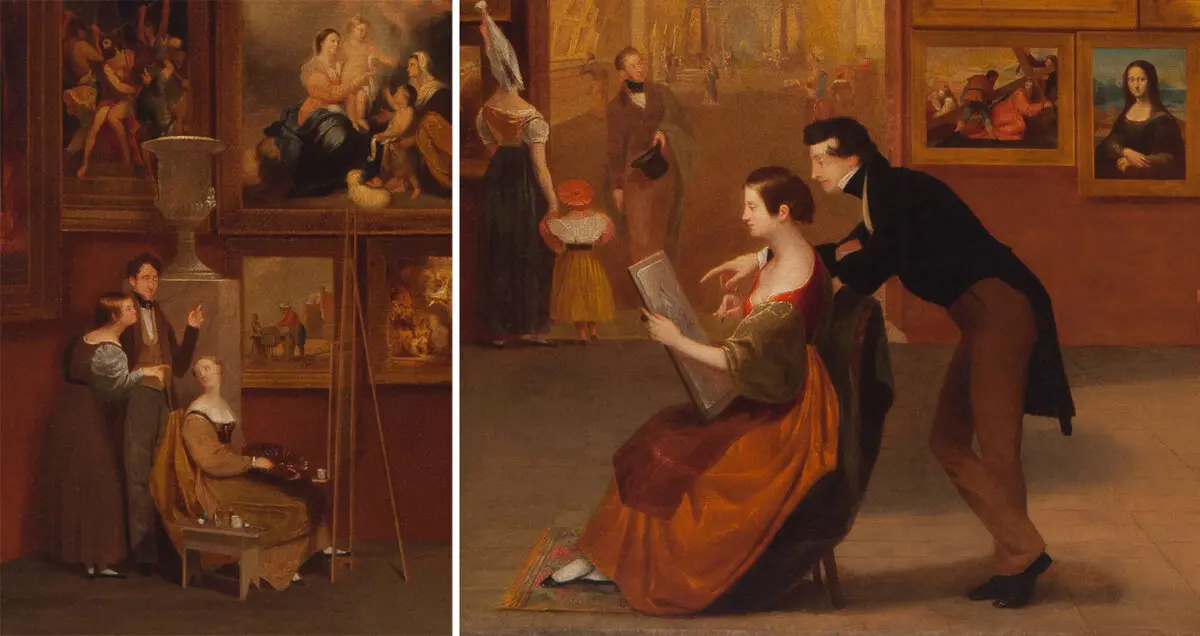
Details of (L) James Fenimore Cooper and his family and (R) Morse instructing student from “Gallery of the Louvre,” 1831–1833, by Samuel F. B. Morse. (Public Domain)

He placed this painting on exhibition twice, in New York City and New Haven. Although it was commended by critics and art aficionados, the public was indifferent. The artist was demoralized. Coupled with losing out on a federal commission to paint a monumental work for the U.S. Capitol Rotunda, Morse put down his brush permanently and pursued electrical experiments instead.

An Invention Sparks

During his transatlantic crossing in 1832 from France to the United States, Morse met Charles Thomas Jackson (1805–1880), who had in-depth discussions with him about electromagnetism and invited him to observe his experiments. This sparked Morse’s idea for developing a means of speedily transmitting long-distance messages over an electrical wire.

Morse developed a device that could send coded messages through a single wire telegraph. In 1843, the House of Representatives passed a bill authorizing him to construct an experimental wire between the Supreme Court Room in Washington and a Baltimore railway depot 40 miles away. On May 24, 1844, he sent the first telegraph message. His device was more efficient in design than other electric telegraphs.
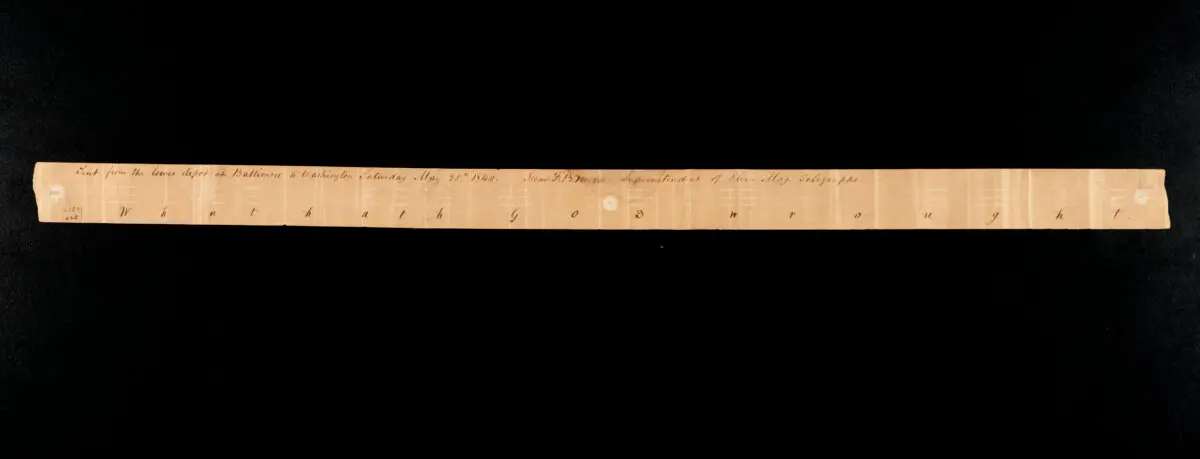
Morse’s telegraph message, “What Hath God Wrought,” sent and transcribed on May 24, 1844. National Museum of American History, Smithsonian, Washington. (Public Domain)

This, along with the development of Morse Code, a system in which letters are represented by combinations of long and short signals, brought him fame and fortune. Morse’s work transformed long-distance communications technology and is considered the forerunner of today’s email.

From May Issue, Volume VI
Categories
Features History

The Maverick Engineer

The hourlong flight across lower Michigan was nearing completion when Ed Cole found himself in fog on his approach to Kalamazoo. It was May 2, 1977—an otherwise routine Monday morning. Before takeoff from Pontiac, the suburban airfield north of Detroit, Cole had chatted in a “jolly” mood with a hangar employee and mentioned seeing purple martins at home. After nursing a cup of coffee, he defied the weather warnings, choosing to rely on the instruments in his twin-engine Beagle S.206.

Lee Huff and her dog witnessed Cole’s last moments.

“The plane circled my house three or four times, and the dog put up such a racket that I ran outside in the backyard to see what was going on,” she told a correspondent. Cole’s plane crashed, causing a “terrible boom.” He was 67 years old.

Shock prevailed among the 400 mourners leaving the funeral service that week. The faces of Henry Ford II, Lee Iacocca, George Romney, and Roger Smith reflected incomprehension, as if the premature death of such a towering figure was impossible.

Weeks before his death, Cole had signed up to run Checker Motors Corp. in Kalamazoo, located about 60 miles from his own native village of Marne (formerly Berlin), Michigan. Founded in 1922, Checker made about 5,000 cars per year of the Marathon. This sturdy, dowdy sedan, introduced two decades earlier, was popular with taxicab services. In other words, after General Motors (GM), Ford, Chrysler, and American Motors, Checker was the fifth-largest automaker. “I’m number one at number five,” joked Cole, who liked to gab with reporters.

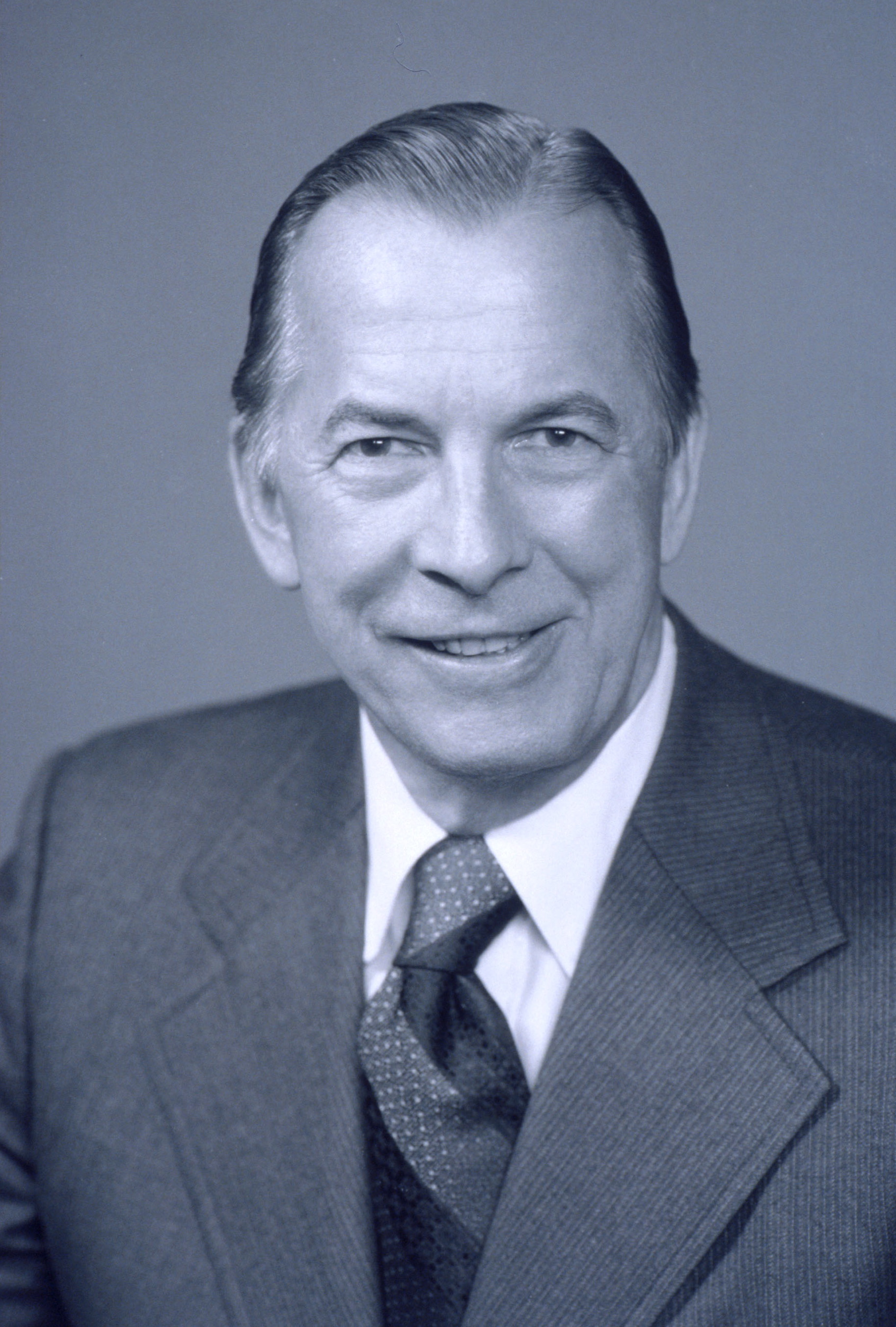
Edward Cole, GM’s pioneering engineer. (Courtesy of GM)

He had retired as GM president 3 1/2 years earlier. His career started in 1930 with a 45-cent-per-hour job in the corporation’s Cadillac Division. Until the 1950s, the divisions within GM were self-governing; Cadillac had its own suppliers and plants for cars, but also manufactured battle tanks for the military. Besides working on GM’s first automatic transmission, Cole straightened out issues in tank performance. He became chief of tank design in 1943. When World War II ended, he worked on Cadillac’s new V-8 engine. Then, as the Korean conflict broke out, he was put in charge of the Walker Bulldog tank.

Flying his own Beechcraft Bonanza, he searched around for a factory and found a building in Cleveland, but had to remove 39 million pounds of beans. A staff of 7,000 people was hired to assemble the tanks. Cole told a newspaper that his team of 14 managers and he worked so hard to get the operation up and running that they were “eating four meals a day and getting skinny.”

The late automotive editor David E. Davis Jr. knew Cole. “There was nothing he couldn’t accomplish, no problem that couldn’t be solved,” Davis once said.

Cole would have been happy to stay put, but the Chevrolet Division called in 1952. “I was doing my own thing and designing engines in my department,” he said. His talents were needed elsewhere. “At that time, Chevrolet was making a little six, a grandmother-type car. Nobody had ever built an enthusiast-type of car around Chevrolet.” Ford had featured its V-8 engine since 1932. Chrysler had just introduced its Hemi V-8, which would become legendary. Cole and the boys got together in a room at Cleveland’s Lakeshore Hotel and drew up plans for the new Chevy V-8 “as a form of entertainment.”

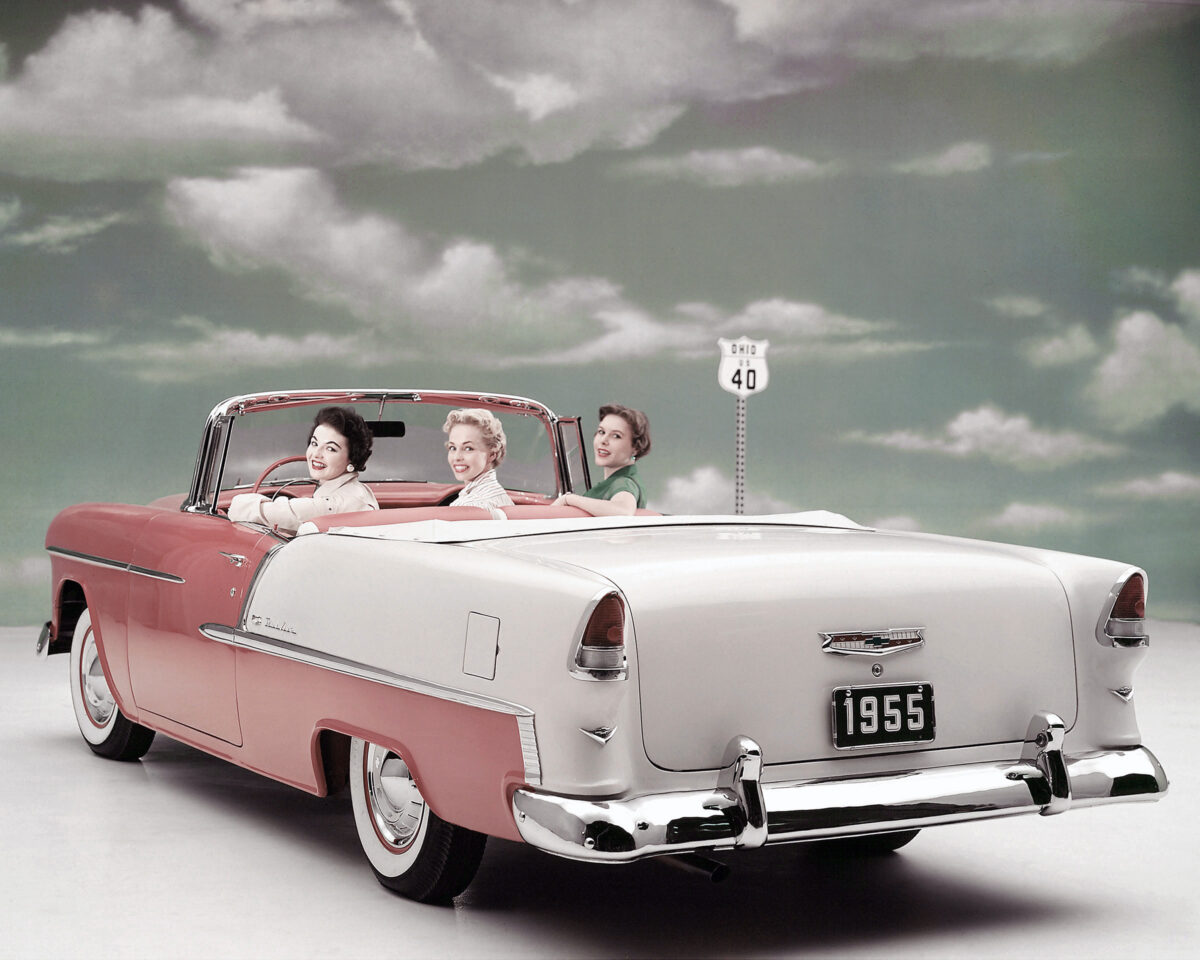
Being appointed as Chevy’s chief engineer and returning to Detroit, Cole led the development of the compact lightweight power plant with four cylinders banked to one side, four more to the other, and a 90-degree “V” angle between them. It incorporated all of the latest internal design features and some breakthrough manufacturing techniques. The V-8 would make its debut in the 1955 Chevy. GM’s top boss, Harlow “Red” Curtice,” stepped into the picture and said he wanted the car to have a “hound dog” look. Cole stopped by the design studio almost every day to see it take shape.

Designer Clare MacKichan was used to old-style, bullying managers, but Cole was different. Besides having good taste, he could handle people. “If he didn’t know what he wanted, he would wait until you produced something he did want,” MacKichan told interviewer Michael Lamm. “And if he didn’t like something, he was pretty nice about it. He wouldn’t get all excited and make a big fuss.”

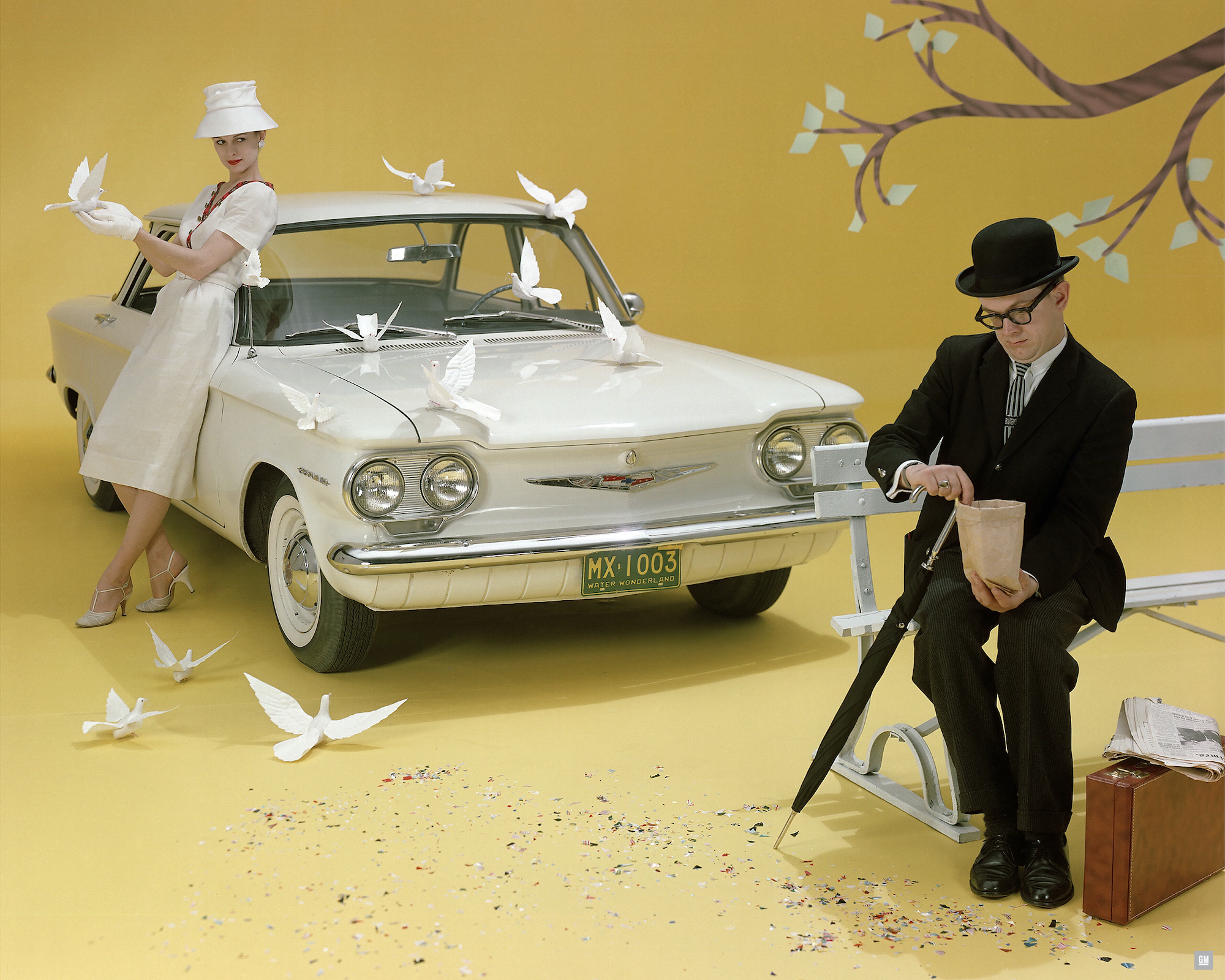
The ’55 Chevy was a smash, selling 1.7 million cars. The Chevy V-8 went into the Corvette next and suited it like honey on a biscuit. Cole rose to division manager and had a free hand to create another car, the 1960 Chevrolet Corvair. And that car would put him on the cover of Time magazine. “If I felt any better about our Chevy Corvair, I think I’d blow up,” he said. It was an unintentionally portentous remark. The compact had an unusual layout, with the small engine placed in the rear—like the Volkswagen. Although initial sales were strong, problems crept in. Micromanaging and cost-cutting by GM’s executive committee had contributed to the Corvair’s tendency to spin out.

An advertisement for the 1960 Chevrolet Corvair four-door sedan. (Courtesy of GM)

As Cole became GM president in 1967, he faced even more controversy and scandals. An engine-mounting problem in other Chevy models resulted in the unprecedented recall of 6.7 million cars. Beyond this, safety, fuel economy, and emissions controls were emerging as top priorities. Some fun went out of the business, and Cole was concerned about the effect on engineers and innovation: “They will be afraid to death to do anything out of fear it might be wrong.”

A month after retiring from GM, Cole appeared on The Phil Donahue Show to debate Ralph Nader, whose exposé, “Unsafe at Any Speed,” was the Corvair’s undoing. When the two-hour broadcast wrapped, Cole shook Nader’s hand, saying, “Give me a little credit from now on. I showed up.”

Nader taunted back, “You got the lead out of gasoline. Now how about getting the lead out of GM?” It was a little rude, but Cole was out of the game by then anyway. Decades later, we remember him for his 18 patents, dynamic leadership, gregarious personality, and the motto: “Kick the hell out of the status quo.”

Ronald Ahrens’s first magazine article was 40 years ago for Soap Opera Digest. His contributions to the much-lamented Automobile Magazine spanned a 32-year period. Nowadays, he’s on a 15-year run with DBusiness (“Detroit’s Premier Business Journal”). Ronald lives near Palm Springs, Calif., where he struggles to understand desert gardening.

Categories
History

The Education of Inventor Michael Owens

Michael Owens came from Irish stock. His family had escaped a potato famine and an oppressive British regime by immigrating to America, eventually settling in Wheeling, West Virginia. Here, there was mining work to be had. Being poor and one of seven children, it was important for 9-year-old Michael to contribute to the family income. Into the mines he went. The year was 1868.

One day, Michael was struck in the eye by a piece of coal, accidentally let loose by the overzealous swing of a fellow miner’s pick. The blow knocked the boy to the ground, and out cold. Mrs. Owens immediately decided that young Michael’s coal mining days were over. At age 10, then, he went to work as a “blower’s dog” in a local glass factory.

Ironically, coal remained a major part of the boy’s job. As a blower’s dog, Michael assisted the (adult) glassblower by keeping the furnace filled with the sooty stuff. The constant heat—not infrequently burning the boy—ensured that the soda ash, sand, and other ingredients mixed inside large pots and placed in the furnace could melt into blowable molten glass. The crew with whom Michael worked (perhaps half a dozen men and boys) produced roughly one glass bottle per minute.

Young Michael Owens worked 60-hour weeks. He was paid 30 cents a day. He went home each night covered in ash and coal dust. It’s a fair bet that his lungs were full of ash and dust, too.

Throughout his teens, Michael rarely if ever had the opportunity to benefit from a traditional school setting—but as the years passed, the lad gained a reputation as a diligent worker. He came to be meticulously trained in every aspect of the glass-making process. “Young or old,” Owens told an American Magazine reporter years later, “work doesn’t hurt anybody.”

At 20, Michael was still in the glass business, but now he was an employee of Edward Libbey’s Toledo Glass Factory. And Edward Libbey had money to invest in Michael Owens’s big idea.

Inventing a Bottle-Making Machine

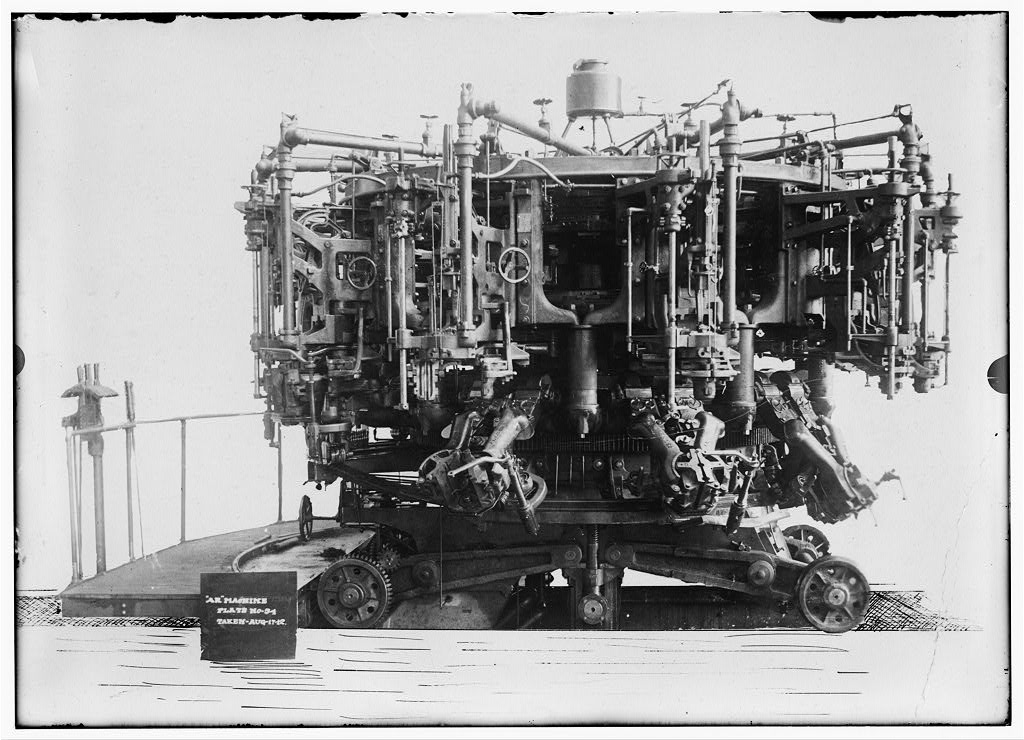
It took Owens five years to produce it, then a few more to perfect it, but in the end (and after burning through half a million of Libbey’s investment dollars), he’d done it. Michael Owens had invented a working automated bottle-making machine.

With six rotating arms (later more were added), each outfitted with a pump and a plunger that could suck up the molten glass and then push air into the mix, bottles were “blown” without a single human touch. The machine even cut the bottles and set them on a conveyor belt, which guided them into a furnace for final heating and cooling.

Even the first version of Owens’s machine was unquestionably more efficient than the most skilled human team of bottle makers. Thanks to his invention, one bottle per minute was now six bottles per minute. After making improvements, six turned to twelve. And not only could bottles be (many times more) efficiently produced, but they also could be more cheaply produced, since expensive, skilled blowers were no longer required. In addition, all bottles were now identical—sharing the same dimensions, the same weight, the same everything. Costs per bottle plummeted 94 percent.

Libbey and Owens quickly co-formed a new company in 1903, the Owens Bottle Machine Company, stocked with the new machines, which the two now licensed out to other companies. Within just a few years, Owens’s automated bottle-making machines could crank out almost 250 bottles per minute!

Founding Big Companies

Owens and Libbey went on to establish the Owens Bottle Company (1919) and, despite frequent criticism from doubters, collaborated over the years with another inventor, Irving Colburn, to perfect the production of distortion-free plate glass. The trio succeeded, and the Libbey-Owens Sheet Glass Company (1916) went on to make millions, too.

Now in his 60s, some wondered if the indefatigable Owens was considering retirement. “The real reason I keep on is because I like to [work], I want to work,” he is reported to have said. “It is the most interesting thing in the world, and it is the most constructive thing. I’ve enjoyed 52 years of it, and I hope to enjoy a good many more.” Owens went on to develop laminated glass for automobiles—he called it “safety glass”—which was much more crack- and shatter-proof than earlier varieties.

Michael Joseph Owens (Courtesy of The Herald-Dispatch, Huntington, W. Va.)

Toledo came to be known as “The Glass City,” Libbey was hailed as the father of the modern glass industry, and Mike Owens died a rich man at age 64 in 1923. In a tribute to the inventor published in The Toledo Times, Libbey described Owens as “self-educated,” possessed of “an unusual logical ability,” and “endowed with a keen sense of farsightedness and vision.” Libbey hailed him as “one of the greatest inventors this country has ever known”—one whose name “will stand out as a pronounced example of what can be accomplished by vision, faith, persistence, and confidence in one’s creative efforts.”

The Owens Bottle Company merged with the Illinois Glass Company to become the Owens-Illinois Glass Company—a Fortune 500 company to this day.

And 60 years after Owens’s passing, the bottle-making machine invented by an erstwhile West Virginia child laborer was hailed by the American Society of Mechanical Engineers as “the most significant advance in glass production in over 2,000 years.”

Dr. Jackson, who teaches Western, Islamic, American, Asian, and world histories at the university level, is also known on YouTube as “The Nomadic Professor.” You can follow his work, including entire online history courses featuring his signature on-location videos filmed the world over, at NomadicProfessor.com