Categories
Features Your Stories

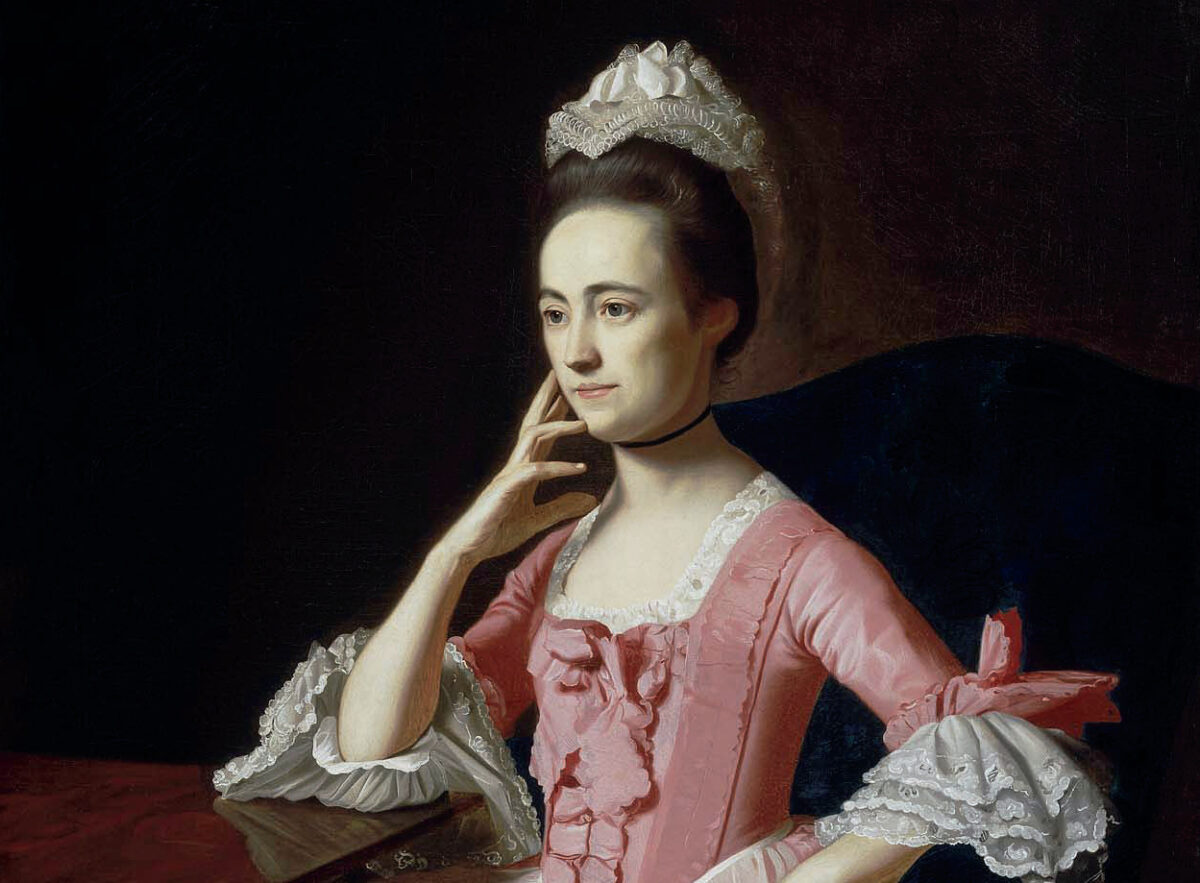
Reflecting on My Family’s Legacy That Traces Back to Dolly Quincy Hancock

What I’ve come to appreciate in my own life is that family culture and behavioral traits are passed down through the generations. For as long as I can remember, I knew I was the five times great-nephew of John Hancock, one of the Founding Fathers and major financiers of our nation. My mother would make references to her ancestors and told me brief stories of our family’s past. John Hancock married into the Quincy family, my family.

I found unfathomable narratives in history books, reading them like heroic fairy tales: the Battles of Lexington and Concord, the Battle of Bunker Hill, and the Siege of Boston, just to name a few. Each conflict strengthened the Quincy and Hancock family bond. I marveled; why did John Hancock and his wife Dolly risk everything to help establish a nation rooted in liberty?

John and Dolly had two children who sadly didn’t survive to adulthood. Dorothy “Dolly” Quincy was the aunt, godmother, and namesake to my maternal great-great-great-grandmother, Dorothy Sewall May. Dolly was descended from a deacon, a reverend, a colonel, and a judge across the generations. The Quincys were a quintessentially New England family all the way to my mother, Margaret, who was born and raised in Massachusetts.

Today, when I read books and letters, both about and by my ancestors, I am reminded of the Quincy and May character that lived in my mother. Above all, it’s their integrity that stands out, and it’s undoubtedly a strength that’s founded on their Christian faith. The history behind my mother’s bloodline also reminded me that it wasn’t just the Founding Fathers who risked everything, but they did so with their wives supporting them in a plethora of ways.

I grew to appreciate that the American Revolutionary War is inextricably linked to the Colonists’ belief in God’s righteousness. Our Founding Fathers had two choices: to establish that all our rights come from men and man’s law; or to establish natural law, the idea that all our rights are God-given. From the fervent prayers at the first Continental Congress to the way natural law is the foundation of America’s legal system, God’s name has been invoked as our claim to freedom and liberty. This was established in the opening text of the Declaration of Independence, that our rights as citizens are not derived from the government, but rather “endowed by our Creator.”

Deep spiritual faith also endured in Dorothy Sewall May’s husband, Col. Joseph May. I actively searched for his will and last testament as if seeking a hidden treasure, a clue to the mysteries of my ancestors. In his final words, he movingly wrote, “I desire to record my gratitude to Almighty God for his singular favor to me through life … mercifully visited as it has pleased him, with a share of disappointments and bereavements: but always sustained by unwavering confidence in his wisdom, which cannot err, and in his goodness, which is unchangeable and everlasting.” Col. May outlived his wife and several children, so for me, this sentence sums up his steadfast faith in God. He dutifully led his family spiritually and supported his son, Samuel Joseph May, through his Harvard University education. Samuel eventually became a reverend, devoted abolitionist, and suffragist from the 1830s until his death in 1871.

Although my mother lived her Christian faith fully, she kept it private. She led by example. And as far as I know, my mother not once missed her right to vote her entire adult life, knowing what her ancestors had sacrificed.

After two decades as the wife of a U.S. Army colonel and diplomat, she was denied healthcare after an unwanted divorce. She fought the legal system all the way to the U.S. Congress and won. She led the way and had a determined courage for justice. I admire that about her. For all my ancestors, their Christian faith carried them through turbulent times.

Examining my mother’s handbag after her death, I was surprised to find a note written in her unsteady handwriting, where she had inscribed the Ten Commandments and the Seven Deadly Sins. I knew she wanted those reminders to strive to live a life worthy of honoring God. My mother always had a strong sense of right and wrong, an audacity for justice. I believe that was carried through her from her ancestors, who risked everything to help create a freer nation 250 years ago.

Today, all Americans are beneficiaries of this heritage, the idea that serving God faithfully is what championed our freedom. My mother didn’t tell me too much about our family history; it was already imbued in her life. It’s that part of her, woven into the tapestry of my family’s Christian heritage, that I cherish the most.

From July Issue, Volume VI
Categories
Features

How an Immigrant From a Village in Italy Surpassed All Odds To Become Mayor of New York City in 1950

Everything in Manhattan’s Italian Rifle Club is quiet elegance: the glint of brass, glimmer of crystal, gleam of polished oak, soft ring of fine china, bell chime of silverware, as in real silver. But the evening’s menu is an anomaly, a plain old green chalkboard, mounted in a dull wood frame and set on rollers that the waiter brings by our table. Several appetizers, soup and salad of the day, a half dozen entrees.

No prices.

I nudge my Mom. Why no prices?

“Why don’t you ask your Uncle Vince?” she suggests, referring to my great-uncle, my grandmother’s brother, the unquestioned head of our family—and our host at this celebratory dinner in 1965.

“Because,” Vince tells me, “if you have to know the price, you don’t belong here.”

He turns to our waiter—resplendent in tux, silk shirt and black tie—for corroboration.

“That’s right, your honor,” declares the latter, deferentially.

Everyone chuckles, including my mom, whose birthday this is. While such a remark today would seem atrociously elitist, those were different times, and Uncle Vince, as we all called him, represents a story of origin that itself seems today almost a cliché—poor immigrant boy grown into self-made man. But it’s all true, his blood is mine, and it starts in a tiny mountain village in Sicily, makes its way to the residence of the mayors of New York, Gracie Mansion, and ends in a midtown Manhattan penthouse where, as a young teen, I’d stand awestruck on the balcony and gawk at the glistening spire of the Empire State Building a few blocks distant.

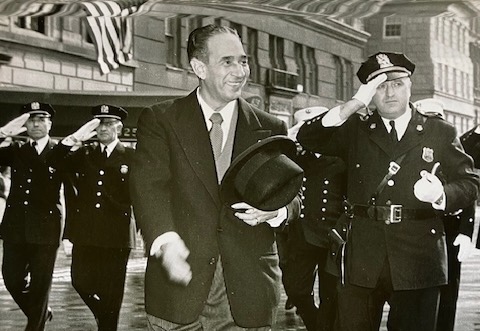
Arriving at said apartment building, if I were to walk in with Vince, the doorman would rise from his lobby chair and salute. “Afternoon, your honor!” Vince would nod genially.

What on Earth is all this? Who is this gentleman so distinguished that random people call him by a fancy title and salute him on sight?

Vincent (Vincenzo) R. Impellitteri was born on February 4, 1900, in Isnello, a village about 50 miles from Palermo, perched astride a shoulder ridge beneath the dark granite battlements of the Madonie mountain range, which houses the second-highest peak in Sicily. A year later, his parents decided to seek a better life in America. The family sailed to New York, then relocated to Connecticut, settling in a riverside mill town, Ansonia, where Vince’s father Salvatore set up shop to practice his trade—shoe cobbler.

My grandmother Rose was born soon after; she and Vince enrolled in Ansonia schools and began their upward path into American life. She married a Ukrainian immigrant’s son and became a schoolteacher, while her husband, William Comcowich, rose through the school system ranks to eventually become Ansonia superintendent. My mother, Therese, was born in 1929, and she used to recount how her Sicilian grandmother, Salvatore’s wife Marie, who watched my mom after school while my grandmother Rose worked, never learned English and spent the entire rest of her life in that small Ansonia immigrant neighborhood, where her outings consisted of going to the Italian grocery store and the local Catholic church once a week each.

To say Vince went a different direction is putting it mildly.

Quietly on fire with ambition, he graduated with good grades from Ansonia High School and enlisted in the Navy, serving as a radio officer during World War I. After the war, he headed down to New York, where he wound up attending Fordham University School of Law by day, working as a bellman and desk clerk at night in a Manhattan hotel. After graduation, he joined a large, politically connected law firm, then was an assistant district attorney in Manhattan for a decade, then became clerk to a couple of state judges, then was chosen as deputy-mayor running mate for William O’Dwyer, on the basis of his ticket-balancing Italian ancestry, steady personality, and Democratic party loyalty.

They won two terms, then O’Dwyer resigned just as a corruption scandal broke over his office and Tammany Hall, the Democratic “machine” that ruled New York. O’Dwyer absconded to Mexico, and a special election was called for the remaining three years of his term.

I’ll run, said Vince. Nope, said Tammany Hall. Vince lost the primary to the Tammany candidate, but he created his own organization, the “Experience Party.” You’re toast, party bosses told him.

We’ll see, said Vince.

“He does not create emergencies,” wrote the New York Times. “He gives the impression of dogged earnestness and good intentions.” He acquired the nickname “Impy.” His slogan was “unbought and unbossed.” Supposedly, the Mafia controlled Tammany Hall, but Vince had snubbed Frank Costello, the Luciano crime family boss.

Impy beat three other candidates by more than 225,000 votes to become the city’s 101st mayor on November 14, 1950. A few years later, I joined him for Thanksgiving dinner at Gracie Mansion with my mom, his favorite niece. I was 15 months old; I don’t remember a thing, but I have the picture of me in my high chair. I presume we had roast turkey and cannoli.

In 1953, when the next election came around, Tammany Hall took him seriously and bumped him from office with Robert Wagner, a titan who went on to serve three terms in Gracie Mansion. Shortly after Wagner took office, he made Vince a judge, and he spent the rest of his career on the bench. Thus “Your Honor.”

Instead of dogged earnestness, I remember a courtly, well-tailored, gentlemanly, understated patrician. Is that an elite term? Sure, but look at his life: He earned it, full on, hard work, no question.

“To say that Vincent Richard Impellitteri rose from obscurity would be an understatement of the first magnitude,” declared the New York Times in Vince’s 1987 obituary. “In an era of flamboyant politicians and corruption scandals, Mr. Impellitteri—deliberate, scholarly, mild to the point of shyness—struck a responsive chord with New York voters and became the first person ever to become mayor of New York without the support of a major political party.”

Vince returned to Isnello in triumph on a quasi state visit in late 1951; at the time, the mayor of New York was widely considered the second most significant political office in America. Sicilians gave him a parade through his birthplace, lining the bannered streets and tossing flowers. I still have the commemorative engraved silver box they presented him, containing a glass ampule with a quarter-cup of Isnello dirt. Yes, really.

We live in an age when origin stories such as this are scoffed at as clichés, while millions of people hand Hollywood billions of dollars to parse out so-called superhero lineages that require advanced Excel flowcharts. If I shopped Vince’s story to a producer, she’d say, “Where’s the conflict? The suspense? The existential crisis?”

My sister Kristin and I had a miniature existential crisis when we journeyed to Isnello 10 years ago, just to see. Shortly before she died, our grandmother told me it was a dusty, backward mountain village and why would anyone go there? But we went anyway and found a lovely, fully restored town in a gorgeous setting with spruced-up houses testifying to European Union rural improvement funds. It was serene, well kept, quiet, and devoid of any hint that it was Vince’s hometown. No statue, no eponymous plaza, nothing.

So we thought. After traipsing up and down for a couple of hours, we parked on a bench on the main drag, puzzled. Then, Kristin, glancing about, raised her eyebrows and pointed to a blue-and-white tile plaque on the concrete abutment right behind us.

It read “Viale Vincenzo Impellitteri.” A nearby street sign said the same.

We headed happily to the edge of town to an uncrowded café with a viewscape patio and celebrated with a sensational lunch of almond risotto, peasant bread, and olive oil far better than any you can get in the United States.

Are there shoe cobblers left in this world? Young men who work nights to go to law school by day? I don’t know. I am neither of those, although in my entire life I have had just three months when I did not work or go to school, and I intend to keep it that way.

I wouldn’t say Vince told me to do that. He showed me—showed us all—which is far more meaningful. Make your own way, pave your path yourself, do something worthwhile.

As a boy, I’d watch Vince open a box of illicit, expensive smuggled Cuban cigars (he had connections), cut them, and carefully lay them in one of the ceremonial burnished walnut cigar boxes he received as mayor. I’d ask what they were.

“Contraband,” he explained, grinning genially.

My good fortune to have an ancestor like Vince is happenstance. His influence in our extended family has been profound. Though no member of the generations who came after him has reached his lofty heights, he had many nieces and nephews and grand-nieces and -nephews and we have all, every one of us, carved worthy lives for ourselves in this complicated world.

Maybe you have such a forebear, maybe you don’t. We cannot arrange our ancestors. But we can choose what sort of example we set for those who will come after us. When I think of that challenge, I think of my Uncle Vince, who worked his way up to the pinnacle of American life for a worthy goal, and left us a superbly worthy legacy.

From Nov. Issue, Volume 3