Categories
Features

Woman With Disabled Adult Son Finds Her Purpose in Spotlighting the Caregiving Crisis in America

When Jessica was pregnant, she got tough news from her doctor: Her unborn child would either not survive, or have severe special needs. Fortunately her son Lucas did survive, though he faced many physical challenges: level 3 autism, intellectual disability, Chiari malformation, hydrocephalus, scoliosis, low muscle tone, and low vision. He would require round-the-clock care for the rest of his life.

Five years later, Jessica was slammed with another challenge: Her husband Jason, age 30, passed away. The Michigan-based widow accepted life as a single mom of four children. At least, until a prayer at her husband’s funeral: “My mother-in-law, Jason’s mom, actually pulled me aside at the funeral and said, ‘Jess, I just want you to know I’m praying for your next husband.’ I thought, I don’t think I’m anywhere near even thinking about that, but you know, that would be great someday.”

Apparently, some prayers go to the top of the stack.

Shortly after the funeral, Jessica started posting about her experiences on her blog. A reader reached out, telling her about an Oklahoma man named Ryan Ronne with three children, who had recently become a widower. The reader suggested they get in touch to share experiences. They started swapping emails, then met.

Though Lucas has severe physical and mental challenges, he has impeccable timing in matters of the heart. He only has about 30 words in his vocabulary, but he used the perfect one when he met Ryan for the first time: “Dada.” The kid was a matchmaker! Jessica and Ryan were engaged a few months later and now share a life together as husband and wife. They later welcomed a child of their own.
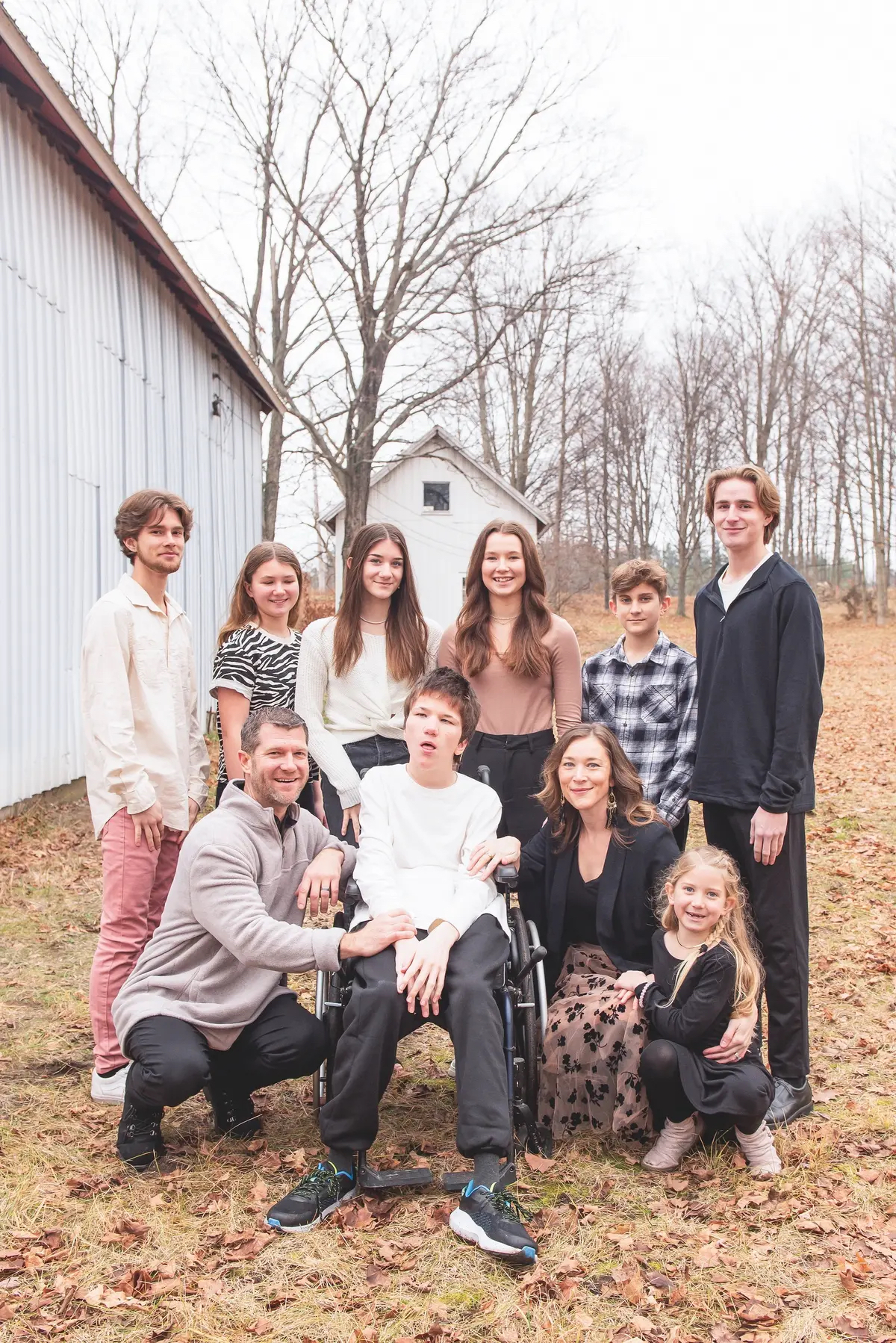
Ronne, her husband Ryan, and their entire blended family. (Courtesy of Jessica Ronne)

Caregiving 24/7

As Lucas got older, the Ronnes started experiencing the physical and emotional toll of taking care of him 24/7. “We weren’t made to live in survival mode year after year,” Jessica said. Their other children would take over and give them an occasional date night so they could recharge.

Looking back on her journey as a caregiver, Jessica recalls her original discussion with her first husband Jason before Lucas was born. “My husband and I went out for dinner, and I saw a 20-year-old, profoundly disabled young woman in a wheelchair with her parents, and she was drinking from a sippy cup. I said to Jason, ‘I don’t want that. I can’t handle that. I even went home and wrote that in my journal. ‘God, if that’s your plan, that’s not the right plan. I can’t do that.’ That’s exactly what I got.”

It turned out she could do that. What she “got” was a child who simply needed some extra care as he fit right into the family. “I just accepted Luke as Luke and thought, we’ll fight for him to have the best life he can have.” She has relied on her faith over the years. “The Lord did sustain me for 20 years and continues to change me through the blessing of being able to raise Lucas.”

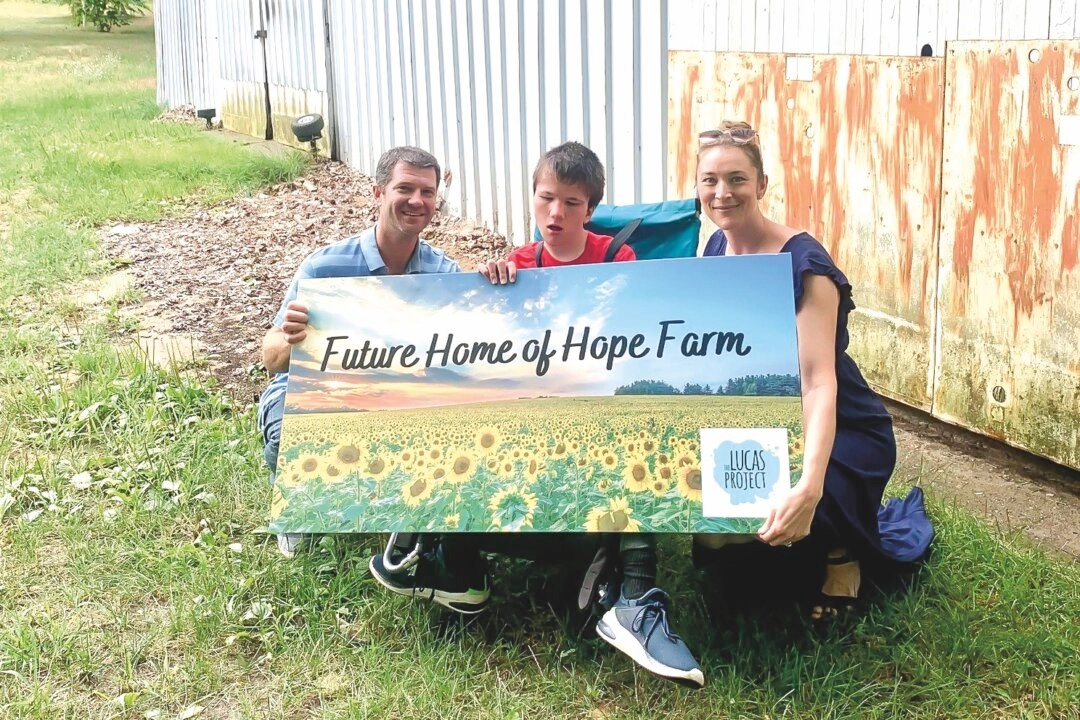
Along the way, Jessica launched a website called The Lucas Project that offers resources for caregivers. Her book, “Caregiving with Grit and Grace,” offers caregivers support and understanding. She also made an eye-opening documentary about raising a special needs child titled “Unseen: How We’re Failing Parent Caregivers and Why It Matters.”
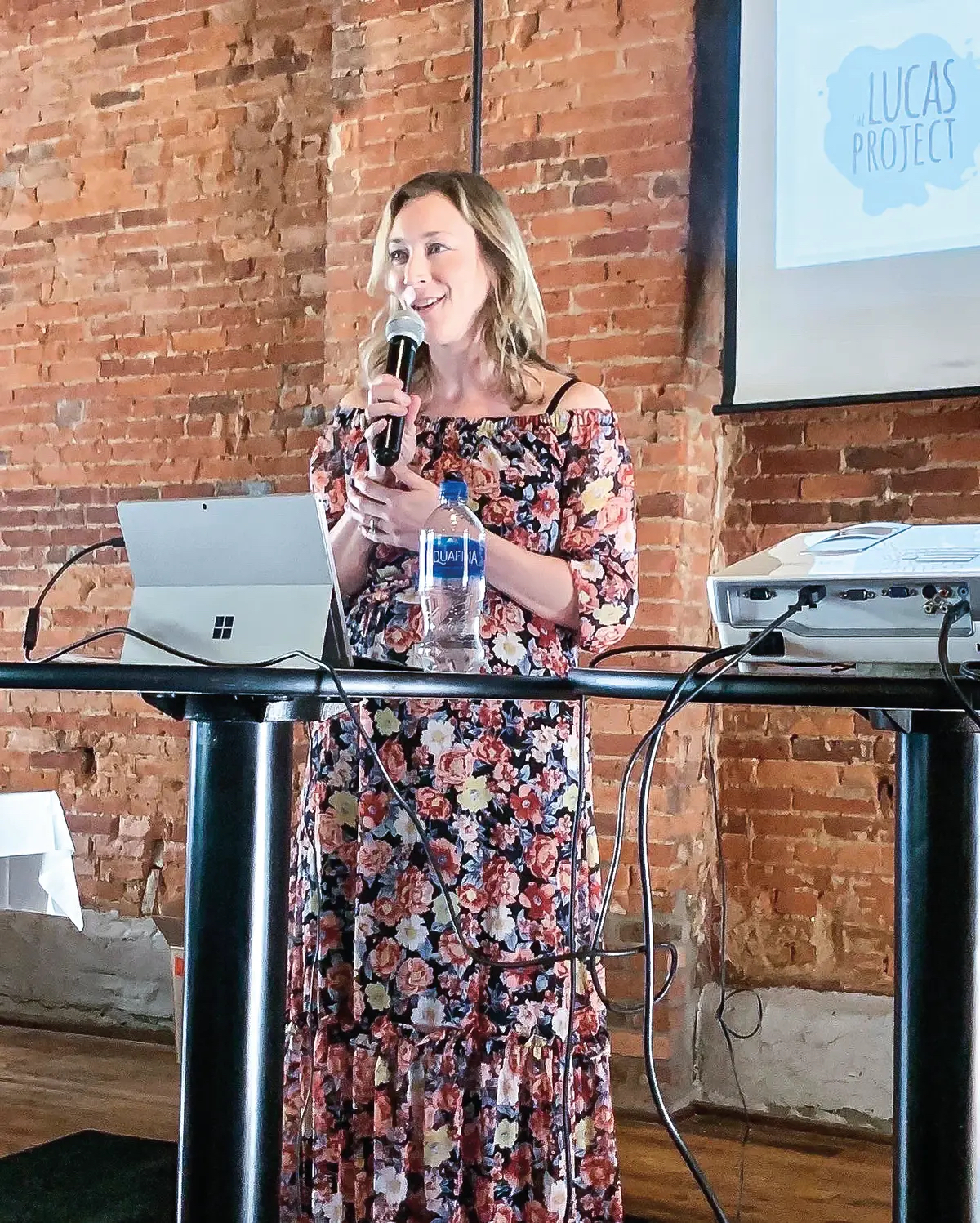
Ronne speaks at events to raise awareness about the challenges caregivers face. (Courtesy of Jessica Ronne)

She hopes to address the shortage of caregivers, both paid and volunteer, who are willing to help parents of children with special needs. “It would be wonderful if people became aware of the problem and wanted to help by volunteering, but the issue with the caregiver shortage is really a problem with the wages the caregivers are paid.” It’s a hard, high-responsibility profession, with poor retention and high turnover, that earns little respect and pays a low wage—about $14 an hour.

The Way Forward

Deep concern still plagued Jessica and kept her awake a night: “The question that haunts parents like me is, what happens to my child when I die?”

So the Ronnes worked on a solution. Recently, they opened a group home for those with special needs. Lucas, now 20, shares it with three others, while two of their older children live close enough to monitor the situation. A home health care agency provides care 24/7, while church volunteers organize activities for the residents. Jessica said Lucas enjoys going on outings with the others. While she and Ryan visit often, they now have time for themselves and their other children.

The experience raising Lucas left Jessica with something she never expected—her son with a 30-word vocabulary turned out to be a teacher. “I often say he has taught me more than any man or woman behind the pulpit ever has,” she said. It has dramatically transformed her perspective about caregiving. “I thought for years that it was the lowest work you could do, very monotonous, very mundane, and I now view it as the holiest work I can do. This side of eternity is caring for somebody who cannot care for themselves.”


Categories
Features

Toward the Finish Line

Sacramento resident John Almeda, 27, has nonverbal autism. However, that developmental condition does not stop him from running marathons. Remarkably, the endurance sport has become his passion in life.

“It’s a gift that opened up to him a world of possibility,” said Vanessa Bieker, his mother. “When John is running, he’s so happy and free.”

Before becoming a distance runner, Almeda suffered from insomnia. A delayed puberty at the age of 17 caused him sleepless nights, according to Bieker. Running around a local high school track ended the spell.

Almeda is deep into long-distance running now. Competing for his second time in the Boston Marathon this year, John started preparing in February by running 40 miles a week, training six days straight, and then resting on Sunday. He ran the 2019 race in downtown Boston, finishing in three hours and 52 minutes.

To prepare for the 2021 Boston Marathon, Almeda worked with a strength trainer and a nutritionist. He also ran hills at elevations to increase his endurance capacity, and stadium stairs (100 up and the same number down) at Sacramento State University to build his hip, leg, and lung strength. In addition, Almeda did yoga to increase his flexibility.

His marathon training usually ends a week before the race, getting “up to running 22 to 23 miles before pausing his training,” Bieker said. Almeda planned not to train “for the pre-race week. That is typical of marathon runners to avoid breaking their bodies down.”

Almeda usually has a guide who accompanies him while racing in marathons, although he ran the Big Bear Marathon, a Boston qualifying race, on his own, according to Bieker. The guide ensures that John eats snacks and drinks fluids, which he can and does forget to do. As of publication time, however, Almeda planned to run the 2021 Boston Marathon without a guide. “He taught me that he can navigate these races on his own, and while as a mother I worry, he proves time and again that I do not need to.”

Almeda began his long-distance running career competing in the Special Olympics in 2014, where he ran five-minute miles. That is, he ran a quarter-mile in one minute and 15 seconds four times in a row—not too shabby for a beginner. John said he follows the advice of the late Satchel Paige, a famous black baseball pitcher: “Don’t look back; they might be gaining on you.”

He ran in races of increasing lengths: five kilometers, 10 kilometers, and then a half-marathon. In December 2017, Almeda ran his first marathon: the California International Marathon, which went from the suburb of Folsom to the state capitol in downtown Sacramento. As fate would have it, Almeda finished that race on a broken ankle (which happened at mile six, according to his mother) in four hours and 20 minutes. “He refused to quit, […] saying, ‘Boston, Boston, Boston.’”

Bieker, like Almeda, thrives on overcoming challenges and helping others in similar straits. She helms the Fly Brave Foundation, a nonprofit that offers career development for adults on the autism spectrum. She launched the group five years ago with five members. Today, there are 450 members. Bieker opened The Fly Brave Emporium, a brick-and-mortar shop, in April 2021; it features a coffee and consignment shop, plus an art classroom that gives space to artists on the autism spectrum to sell their work.

Other runners share their positive feedback with Almeda, according to Bieker. They support him with high-fives and words of encouragement. Non-runners, too, get a lift from Almeda and his running achievements.

“We get letters and cards all the time,” said Bieker, “from families with children who are on the autism spectrum and nonverbal, some of whom are newly diagnosed. They look at what John is doing as a beacon of hope.

“We also communicate with people who have been in accidents. A partially paralyzed woman found John online and reached out to him to share that his life story gives her hope. She goes to John’s Instagram account daily for inspiration and motivation to keep pushing hard.”

Bieker reads such stories to Almeda. “He lights up when he hears them,” she said. “John knows that he is helping others.” Such feedback is a motivating factor in his aspiration to run races longer than 26.2-mile marathons. In February 2020, he ran a 50-kilometer race and came in with the top 15 finishers, completing the 31-mile trail race in under five hours. In 2022, John plans to begin training to qualify for a race that is about three times as long: the Western States Endurance Run, a 100.2-mile race in the Sierra Nevada mountains. It begins in high-altitude Lake Tahoe and ends in Auburn, California. A local runner who has entered and finished the race has offered to run the course with Almeda during his training.

First, John must qualify. Some 1,500 athletes aspire to run that race every year; a lottery system selects 250 qualifying runners. If the past can indicate the future, do not bet against John running and finishing the endurance run in 2024—when he aims to compete in the ultramarathon. After all, John is a young man who, with his untiring mother, is overcoming the odds, and in the process brightening the lives of many others.

Seth Sandronsky is a freelance journalist based in Sacramento, California, married to a wonderful woman for the past 37 years. In a previous lifetime, he was a Division II college football player and competitive powerlifter.